The Senior Engineering Hire Decision Tree for Founders Who Cannot Afford a Three-Month Funnel
Settle role, need, offer, and a three-round loop before sourcing.

For technical founders making a first engineering hire at an AI startup, speed starts with deciding what the hire must solve. Define the role, confirm the need is permanent, build the offer, and agree on a three-round evaluation before contacting anyone. This decision tree explains how to replace a three-month funnel with a process that can reach a decision while strong candidates are still available.
Why the three-month funnel is an internal problem, not a market problem
Founders often respond to a stalled search by looking outward for more sourcing channels or a better job post. The more useful diagnosis is usually inside the company. Undefined hiring criteria, too many rounds, slow feedback, and no single process owner turn an available candidate into a lost candidate. More introductions put more people through the same delays.
The market does make hiring harder. AI skills top the global list of hardest-to-find capabilities, and demand for senior AI-fluent engineers outpaces qualified supply. Active founding engineer candidates are rare, so passive outreach is required for nearly every search. Finalists often have multiple offers. That makes internal drag more expensive, because a company still debating its requirements is competing against companies ready to decide.
When interviewers disagree about what “good” means, each candidate triggers a fresh debate. Extra rounds become a way to postpone resolving it. The founder may read the resulting dropout as evidence of a shallow talent pool, but the process has failed to convert the interest it already earned. The fix starts before sourcing, with decisions that should not be left for candidates to force.
The first gate — deciding whether you need a founding engineer, a CTO, or a senior IC before sourcing anyone
A founding engineer turns an idea into a working product and sets the technical foundation. A CTO owns technical strategy and builds the engineering organization, typically when organizational scale becomes the problem at Series A and beyond. A senior individual contributor delivers within a defined area of an existing system.
The distinction changes both the evaluation and the offer. A skilled CTO may not be the right person to build a product alone, while an outstanding founding engineer may not be suited to managing a growing organization. Each role also calls for different equity expectations and ownership. Hiring the wrong type means optimizing an entire search for the wrong outcome.
Title inflation makes precision especially useful here. “Founding engineer” also appears on roles at companies with substantial existing engineering teams and on jobs closer to senior software engineer. Candidates have reason to question the label. Describe the actual mandate. Before writing the description, answer one question. Which bottleneck does this hire need to solve right now?
The second gate — matching the AI role taxonomy to the company's actual technical bottleneck
For an AI startup, “founding engineer” still leaves an important question unanswered. The company needs to distinguish product reliability, production scalability, and a technical breakthrough. An AI engineer fits a company that needs to make its product reliable. An ML engineer makes machine-learning systems reliable and scalable when models work in notebooks but fail under real traffic. A research scientist or research engineer fits a business that cannot win without a breakthrough in a precise domain.
Research scientist roles almost always require a PhD, while research engineer roles usually do not, though some postings still require a Master's or PhD. Most Series A and B AI startups need a research engineer. A demonstrated portfolio can therefore be relevant evidence without turning the search into a hunt for research credentials.
Enterprise deployment creates another possible branch. Forward-deployed engineering brings together engineering and customer-facing deployment, which may be what the company needs from an AI role it has yet to pin down. The founder must name that need before writing requirements. Otherwise, a product reliability search can become a research interview, and the team will disagree about candidates because it never agreed on the work.
The third gate — stage-based team shape and the contractor bridge decision
Once the work is clear, decide whether it justifies a permanent hire. Early companies can need an owner, a core team member, or capacity. An owner belongs in a technical cofounder discussion with founder-grade equity. A core team member warrants a full-time search. Capacity can be supplied by contractors available in days.
At seed, the working model is two to four founding engineers with complementary capabilities. At early product-market fit, the team grows to three to six engineers and hires its first specialists. Series A brings clearer engineering levels and potentially the first engineering manager. These stages help distinguish a durable team gap from work that needs doing now.
The contractor bridge is a strategic choice. A company can avoid committing too early by settling cofounder-level ownership first, using contractors to ship, and hiring full-time once real usage shows which needs will last. For a seed company, preserving the cap table can justify an hourly premium. Below-market cash plus a small option grant is not an equivalent solution, because strong engineers heavily discount those grants, often to zero.
If you do not yet know which skills the product permanently needs, the full-time search has not started yet.
What senior engineers actually cost in 2026 and how equity narrative quality changes the outcome
A credible offer must exist before the first conversation. Senior IC base pay in San Francisco and New York spans a wide band, while staff and AI-infrastructure roles can clear its top end. There is no supplied dollar range here that would justify a universal budget. The decision input for a “senior engineer” offer is the role's competitive position.
FAANG counter-offers are near-universal at the accept stage in the founding engineer market described in the notes. Cash alone rarely loses the deal, but cash combined with an equity refresh can. Vague option-grant language leaves a founder with little to go on when comparing those offers. Document refresh and acceleration terms in the first offer, rather than trying to explain them after a finalist receives a counter-offer.
Founder fit and product mandate can outweigh cash differences when the vision is concrete and the equity math is legible. CEO and CTO chemistry can decide between finalists' options, but it does not replace an understandable offer. Location also changes the competition. Remote hiring broadens the pool overall, yet a smaller share of research scientist positions is remote than of AI/ML roles. Resolve that constraint before presenting a compensation position to candidates.
How do you hire a first senior engineer fast? Design the loop before contacting candidates
Define “pass” before designing the interview loop. The role, AI specialization, permanent need, and offer must already be settled, because each shapes what the interview should test. Use three rounds as the limit for most senior engineering roles, namely a screen, a technical conversation, and a team loop. If those cannot support a decision, revisit the criteria before adding another conversation. Extra rounds raise dropout risk without a proportional gain in signal.
For a remote or hybrid process, replace algorithm-on-a-whiteboard exercises with work resembling the actual codebase. A live pair-programming session or a scoped task completed with an interviewer watching can show how a candidate debugs, asks questions, and handles being stuck. The aim is evidence of relevant work. That evidence is easier to judge when interviewers have committed to scoring criteria in writing before the session.
Debriefs need their own design. Each interviewer should submit a written scored evaluation and a one-paragraph summary before the meeting. The lowest-tenure interviewer reads first, the senior engineer follows, and the hiring manager goes last. This order makes it less likely that one forceful voice will shape what everyone else thinks. Written evaluations also help keep the last interview from coloring the whole assessment.
Identity verification belongs before the loop begins. Pair-programming and debugging walkthroughs help spot AI-assisted cheating, and senior or security-sensitive roles call for camera-on sessions with hands in view and an editor that flags paste events. Treat those steps as process integrity. Finally, assign one process owner before sourcing. Diffuse responsibility across the CEO, hiring manager, engineers, and recruiter otherwise leaves no one clearly accountable for moving the decision forward.
Where to find senior candidates fast once the process is designed
Fonzi is a fit for senior AI-startup searches that need a compressed process, with a curated marketplace and an AI talent agent available through iMessage with humans in the loop or through a web app.
The networks of founders and investors are the most trusted. Use them in parallel, with the understanding that their reach is limited and the strongest referral may already be employed. A warm introduction makes the first conversation easier to earn, provided the founder can explain the role and move decisively afterward.
Vetted contractor platforms suit a need for capacity but may be a poor fit for some permanent searches. Match.dev publishes rates for senior engineers with 5+ years of experience and offers a 10-hour paid assessment on a real project. Its terms include no fee until hire and a free replacement if the fit is wrong. That provides a concrete way to test working fit without treating a temporary skill need as a permanent equity commitment.
Specialist recruiting firms extend passive reach beyond the direct network. Recruiting from Scratch front-loads the hiring brief, sources candidates who are not on job boards, and typically delivers first qualified submittals within two to four weeks for active searches. The founder still needs a prepared offer and a working interview loop to turn introductions into a decision.
The alternatives also include Paraform, Riviera Partners, Dover, Toptal, Wellfound, Arc.dev, and Lemon.io. The supplied information does not establish their fees, delivery times, seniority mix, or contract-versus-permanent terms, so a defensible ranking on those measures is not possible. Quality varies on freelance marketplaces, and founders must do a lot of screening, so these marketplaces are a better fit here for small tasks with a clear scope.
The useful comparison is signal per hour of founder time. A trusted network, a screened introduction, and a specialist's passive outreach solve different access problems. None resolves an undefined job.
The complete decision framework as a single sequential checklist
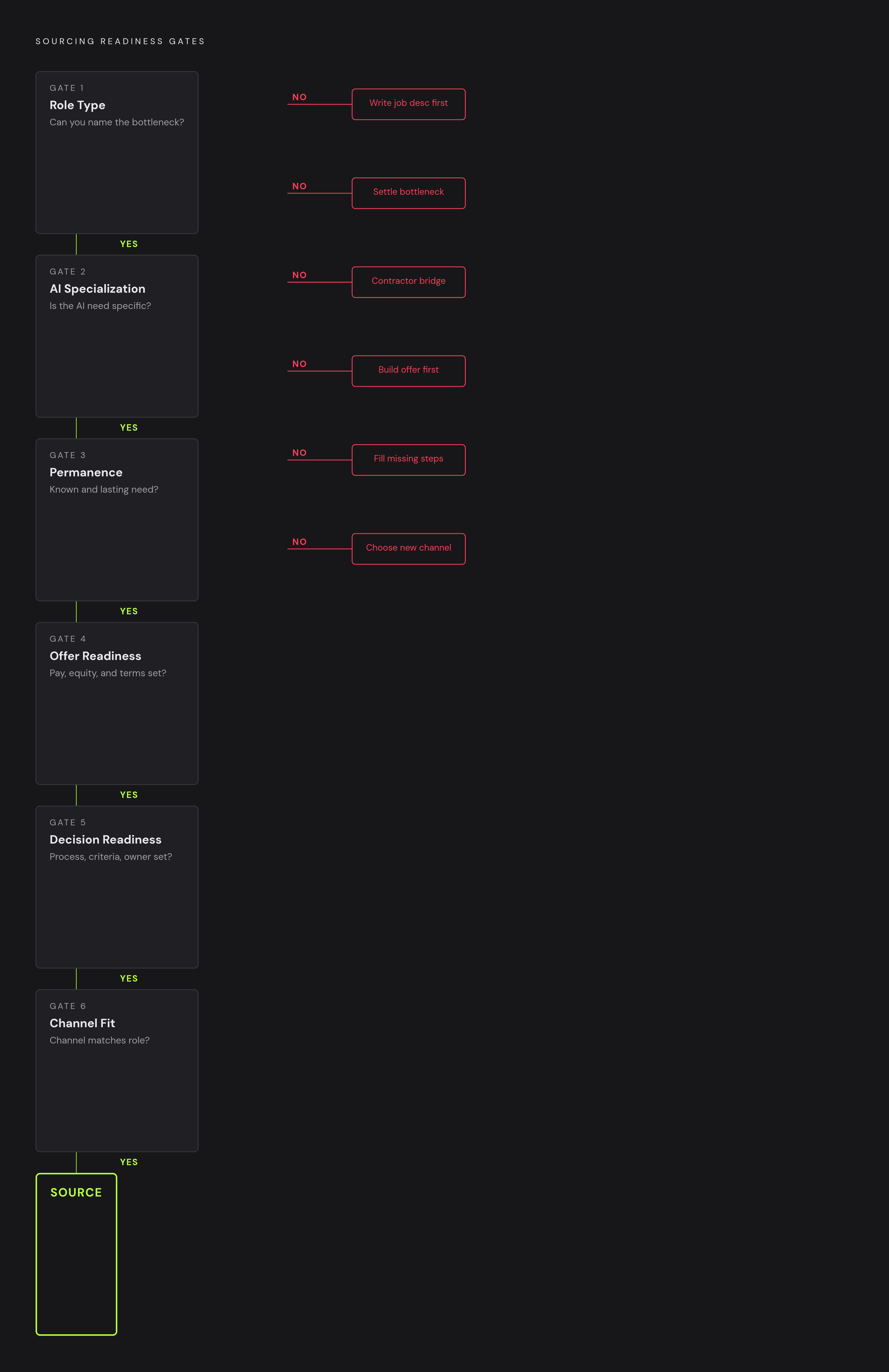
Gate 1 is role type. Can the founder name the bottleneck as shipping, organizational scale, or throughput in a known domain? If yes, select founding engineer, CTO, or senior IC respectively. If no, stop before writing the job description.
Gate 2 is the AI specialization. If the job touches AI, is the need product reliability, production scalability, a technical breakthrough, or customer-facing deployment? If yes, tie requirements to that work. If no, settle the bottleneck before choosing credentials or interview criteria.
Gate 3 is permanence. Is the skill need both known and lasting? If yes, proceed toward a full-time core-team hire. If no, use the contractor bridge while real usage clarifies the lasting need.
Gate 4 is offer readiness. Are base pay, equity structure, refresh language, and acceleration terms ready to present? If yes, proceed to process design. If no, build the offer before contacting candidates.
Gate 5 is decision readiness. Are there no more than three rounds, written scoring criteria, one process owner, a debrief protocol, and identity-verification steps? If yes, sourcing can begin. If no, fill in the missing parts of the process before candidates run into them.
Gate 6 is channel fit. Does the channel match the role and commitment? For a permanent senior AI-startup hire, use a curated marketplace with investor networks in parallel and a specialist firm for additional passive reach. For capacity, use a vetted contractor platform. If the channel cannot help find the chosen type of hire, choose another channel and keep the job as defined.
Can the team make a call against the criteria it agreed on before interviewing? If not, examine the rubric before adding rounds. A compressed loop requires the company to decide what the bar is before asking candidates to clear it.