Where Elite ML Engineers Actually Find AI Startup Roles When LinkedIn Isn't Enough
Elite ML engineers land startup roles by making their work visible.

Elite ML engineers look beyond LinkedIn applications to find AI startup roles by making their work visible where founders, technical peers, and recruiters already look. A curated talent marketplace for elite ML and software engineers joining AI startups should check what they can do, match them with roles, and put salary bids upfront. But the foundation is still proof of work, because a public contribution gives someone a reason to approach you.
Why the strongest ML engineers are almost never looking
Hiring managers in 2026 often need people with a specific mix of skills, including large language model fine-tuning, vector databases, and experience shipping to cloud GPU infrastructure. That describes a small population. Many of those engineers are already deep in production work. Meanwhile, frontier researchers often move through academic pipelines and direct lab relationships.
That makes passive visibility central to how this market works. A resume states what an engineer can do. A merged pull request, authored model, or conference paper gives someone evidence to examine. LinkedIn can surface active seekers, but waiting for inbound applications misses engineers who are building LLM infrastructure or contributing to core frameworks without considering a move.
How the ML job market is actually structured in 2026
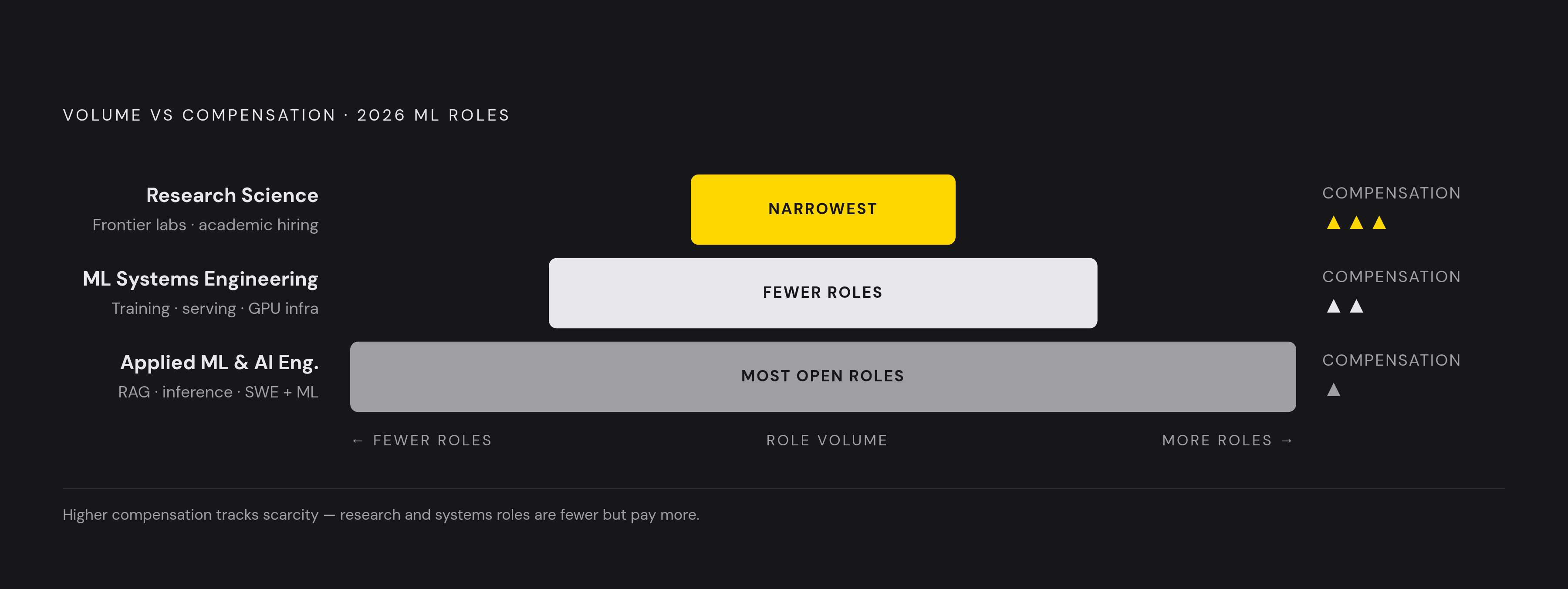
Applied ML and AI engineering make up the large majority of open roles. These engineers build products on existing models, own RAG pipelines, optimize inference, and evaluate model behavior. The work is primarily software engineering with an ML workload. A candidate preparing for research-heavy interviews can therefore miss what an applied team actually needs, which is someone who can turn model capabilities into a working product.
ML systems engineering has a different center of gravity. It covers training, fine-tuning, serving, feature pipelines, and GPU infrastructure, with fewer openings but significantly higher compensation. Research science is narrower still, focused on advancing architectures and publishing at a handful of frontier labs. Its hiring paths lean heavily on academic connections. Meanwhile, titles such as LLMOps Engineer, AI Safety Engineer, Forward Deployed Engineer, and RAG Engineer remain unsettled, so the work described is a better guide than an exact title match.
Proof-of-work platforms where elite engineers are already visible
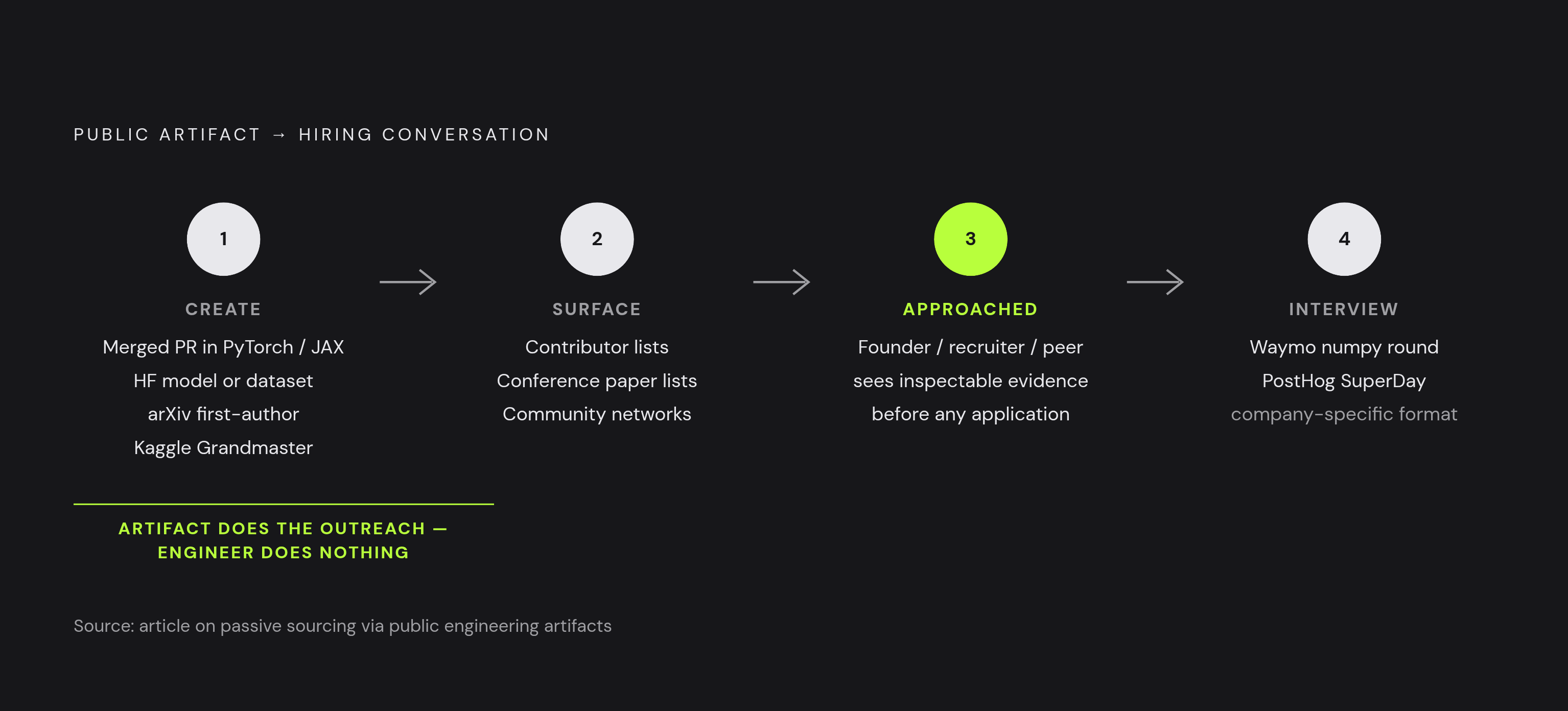
For an engineer, building in public makes technical ability inspectable before a hiring conversation begins. A merged contribution to PyTorch, JAX, or Hugging Face Transformers shows understanding in the context of an actual framework. The work is there to read. Authored models and datasets on Hugging Face offer another route, with model cards and GitHub links giving interested teams a path from an artifact to its author.
First-author papers on arXiv make recent work visible before peer review, and authorship in a relevant subdomain gives labs a direct sourcing signal. Papers with Code was an indexing service linking papers to code, and it shut down in July 2025. Kaggle Grandmaster status is also a verifiable credential, although competition performance does not establish production ability.
The lesson for engineers is to publish evidence that fits the work they want. Not every signal proves the same thing. For companies, contributor lists across PyTorch, JAX, Ray, and production tooling offer a way to find senior engineers who may not respond to LinkedIn InMail.
Specialist boards and community channels that concentrate AI startup signal
Proof of work establishes ability, but a useful board connects that ability to an actual opening. Specialist and community channels earn their place by concentrating AI startup roles and people interested in the underlying work. The advantage is less noise. A broad aggregator can bury a relevant role among jobs that share a title but demand a different kind of engineering.
HN Who is Hiring is one named community channel for reaching senior AI researchers. Its value in this map is the opportunity to encounter hiring conversations outside a generic application feed. Community participation and technical screening are different filters. For an engineer, the useful distinction is whether a channel exposes relevant startup work. For a company, it is whether the people reading already have a reason to understand that work.
Direct employer career pages as the highest-volume source aggregators miss
Companies’ own career pages are the largest source of ML openings, while aggregators index them with a lag. OpenAI, Anthropic, xAI, Apple ML, Amazon science careers, and Microsoft Research maintain active boards. For engineers targeting such teams, the practical fix is a short, manageable company list monitored directly. Waiting for an aggregator introduces an avoidable delay. Direct applicants also give employers a different signal, because they have sought out the company’s work.
Private communities and framework-specific networks where engineers talk before they job hunt
Some opportunities develop before there is anything to monitor. In private research communities and framework-specific networks, engineers talk through problems, share work, and get to know peers before they think of a move. Contribution comes before the job conversation starts. Invitation-only AI research Slack communities run by research labs can ask people to contribute rather than pay to join, so membership itself can show that someone takes part.
The value comes from what people learn about one another through that participation. Someone who already knows an engineer’s work has a basis for making a referral that a cold message lacks. Through those same relationships, companies can reach passive candidates through people they know. Membership alone is not the strategy, because the useful signal is the work that makes others remember someone.
Conferences as recruiting infrastructure, not just networking events
Research conferences bring people from those far-flung networks together in one place where teams can hire. Authors of accepted papers, speakers, and workshop presenters have already passed a technical filter, and their work gives people something specific to talk about. NVIDIA’s NeurIPS 2026 page says the company is looking to hire researchers and engineers who work in AI, robotics, graphics, and more.
ICML 2026 ran July 6–11 in Seoul. NeurIPS 2026 runs December 6–12 in Sydney, with satellite events in Atlanta and Paris December 9–13. The choice of venue depends on where a target team is based. When engineers give a presentation, people can see in person how well they know their field. For hiring teams, public presenter and accepted-paper author lists provide a sourcing document grounded in the field’s own review process.
Founding engineer roles: why they fill through relationships, not postings
Founding ML engineer searches put an additional filter on top of technical ability. Founders need trust, motivation, and an appetite for startup risk, while engineers need to decide whether they want the ownership that comes with an early role. Skill alone does not settle that decision. Most founders never post these roles publicly, and knowing people is the reliable way in because both sides need more than a good technical interview.
The low acceptance rate at seed-stage AI startups comes from how founders weigh risk as well as how few capable engineers are available. That makes volume sourcing a poor substitute for an existing relationship. Engineers weighing this path need to show product judgment and ownership as well as how well they know models. Ember AI, co-founded by Deborah Liu, former CEO of Ancestry, is an example of a company at this early stage. It has raised a $10 million seed round, but that funding and its founder’s background cannot tell an engineer whether the role fits what drives them or how much risk they can take.
What the interview loop actually looks like at the companies engineering these roles
Once an introduction becomes an interview, preparation has to follow the company’s actual format. There is no single ML interview loop. Candidates have reported the Waymo senior/staff sequence as “ML coding round on numpy trajectory data → ML system design round on retrieval of similar driving scenes for training data”. The trajectory data and driving-scene retrieval are not decorative details, because they define the problems the candidate will need to work through.
PostHog’s engineering hiring handbook describes a different sequence as “talent interview → hour-long technical screen → small team and exec interview (on motivation and values) → paid SuperDay”. A co-founder chat occurs inside the SuperDay. The contrast shows why visibility and interview readiness are separate tasks, since an artifact can open the door without preparing someone for the specific exercise or motivation discussion that follows.
The emerging talent-agent model and what it signals about where the market is heading
The talent-agent model takes passive hiring to its furthest expression. Instead of asking an engineer to search and apply, an agent represents them and negotiates their package, much as an agent represents an athlete. The engineer becomes the client. Dex, a London startup, raised a seed round in 2026, signed up tens of thousands of engineers, and charges employers a fee comparable to traditional search.
Series D AI startups are offering research scientists stock grants in the multimillion-dollar range. OpenAI scrapped its six-month equity cliff in December 2025 because of pressure from competitors. A model built around representation responds to a market in which a strong candidate can have considerable leverage without running a public job search.
Curated marketplaces express a related idea for a broader engineering audience. Their distinguishing features are technical screening, matched opportunities, and salary bids upfront. Those are concrete criteria for evaluating a service. A specialist board concentrates relevant openings, a proof-of-work platform exposes ability, and an agent represents the engineer. The structural advantage of a marketplace depends on whether it turns its screening and matching into a faster path to an offer, because strong candidates leave open processes quickly.
How to position yourself to be found rather than to apply
One maintained artifact provides a practical starting point. That could be a Hugging Face model, a contribution streak on a core framework, a preprint, or a conference talk. Choose something that demonstrates the work you want to do next, then keep it useful rather than treating publication as a one-off announcement. Consistency gives others more evidence to judge. It also makes visibility part of the engineering work rather than a separate campaign started when a job becomes urgent.
Alongside that long-term work, keep a short list of companies whose ML stacks you really want to work with. Monitor their career pages directly, and engage within the first day or two when a relevant role appears. Be responsive once a conversation starts, and be ready to discuss compensation clearly. Speed is part of the candidate’s job too. For a founding role, focus more on showing founders ownership and product judgment through people you know than on showing a recruiter your technical credentials.
Finally, make your engineering judgment visible alongside your output. Explain specifically what separates a well-run engineering organization from a mediocre one in community threads, open-source reviews, and conference Q&As. Keep those views tied to the craft. The aim is to give peers a clear reason to think of you when an opportunity appears. Do work they can examine, and participate before you need an introduction.