Pre-Vetted Talent Networks Beat Cold Sourcing for AI Startups Making Their First Engineering Hire
Pre-vetted networks compress hiring timelines when top candidates have short decision windows.
For an AI startup making its first engineering hire, a pre-vetted talent network is a better route than cold sourcing because it moves screening ahead of the search. Technical founders gain time without surrendering the final hiring decision. The best candidates accept offers within two to three weeks, so qualified introductions and a focused interview loop must work together to beat that clock.
Why founding engineer hiring is structurally different from any other engineering search
The first engineer makes decisions that later hires have to work with. For an AI startup, those decisions shape the architecture, the working culture, and the standard for everyone who joins next. Unlike the fiftieth engineer, this person ships without QA, DevOps, or a senior colleague to catch mistakes. Their early architecture choices can persist for years. Hiring the wrong person therefore hurts more than the work in that role, while taking too long to hire holds up the person who will set how the product gets built.
That responsibility extends beyond the code they write. The founding engineer also defines what good engineering looks like when the company begins hiring more people. A mediocre first hire can quietly lower that standard across the team. The search is therefore not simply for someone who can complete the next set of tasks. It is for someone whose technical judgment can support a product now and a larger engineering team later.
Before sourcing, the founder must know how these three roles differ. An AI Engineer builds product features on top of models that already exist. A Machine Learning Engineer builds, trains, and operates models and the production ML systems around them. An AI Research Engineer builds infrastructure and experiments that produce new model capability. These are not interchangeable versions of the same job. Most early teams building on foundation models should hire an AI Engineer first, because hiring a Research Engineer before training infrastructure exists is a common and costly mismatch.
How tight the supply of qualified candidates actually is in 2026
The relevant pool consists of engineers who have shipped AI features in production. That supply is narrow. In 2026, AI-native companies compete with frontier labs and large tech firms for the same shortlist of engineers with evidence of shipping from zero to one. The founding engineer search adds another requirement to that shortlist. The person must be able to work without the support that helps an engineer hired later settle into the team.
Search duration reflects that combination of requirements. Founding engineer searches have a median length longer than most engineering searches, second only to VP Engineering. AI-specific roles also have the longest time-to-fill in software engineering. AI Research Engineer and Staff AI/ML Engineer searches both take much longer than searches for standard software roles, mainly because there are few people to hire and they often receive counter-offers. Those roles are distinct from the first AI Engineer a product startup may need, but they show the pressure on experienced AI talent.
That pressure changes what speed means in this search. The startup needs access to a small group of qualified people while other employers are pursuing the same group. A candidate’s availability is therefore a moving target. A search method that takes weeks to establish technical credibility can reach a sound conclusion only after the candidate has accepted another offer.
Why cold sourcing fails this search specifically — and not for the reasons founders assume
Traditional sourcing takes the better part of two months to complete the average engineering hire. The best candidates accept offers within two to three weeks of entering a process. A startup can work hard on outreach and still lose because it spends too much of the available window deciding who deserves an interview. The failure is not a shortage of effort or a lack of clever messaging.
Cold outbound response rates have fallen as senior engineers receive more inbound options. At the same time, traditional sourcing produces a high volume of submissions with a low submission-to-interview ratio. Most profiles do not warrant a conversation. The constraint has shifted from finding applicants to filtering them quickly, but cold sourcing leaves that filtering with the founder. Screening calls, take-home reviews, and scheduling then compete with investor updates and product decisions, making founder time the most-cited reason for lost finalists.
For non-technical founders, the screening burden contains a second problem. They must judge technical competence without being able to check the work in real time. A skilled engineer knows how to show that audience what they can do, while the founder is less able to tell whether the work is as good as the explanation sounds. More calls do not fix a filter that cannot reliably test the thing it is meant to assess.
Technical founders face a different version of the same bottleneck. They can evaluate the work, but doing so still consumes the calendar needed to build the company. Cold sourcing means they have to find candidates, check that they meet the baseline, and judge fit while the search is underway. Each task takes up some of the time before the candidate makes a decision. Better outreach alone still leaves them with the screening work that costs the most time.
What pre-vetting actually does to the hiring timeline
With pre-vetting, baseline screening happens before the role opens. The work still has to be done and still calls for technical judgment. Instead, the network does that work upstream, so the active search begins with candidates whose qualifications have already been assessed. The founder’s first question changes from who might be qualified to which qualified person fits this company. That shift removes discovery and basic verification from the founder’s immediate workload.
A truly pre-vetted candidate has had their skills, employment history, and work authorization checked, along with whether they are available and want the job. A resume filter only sorts candidates. A ten-minute phone call also falls short of showing whether someone can do the technical work. Strong vetting includes a technical assessment reviewed by someone who does the work. For AI engineering, that assessment must match the stack and deployment context, because a general ML quiz does not establish LLM production experience.
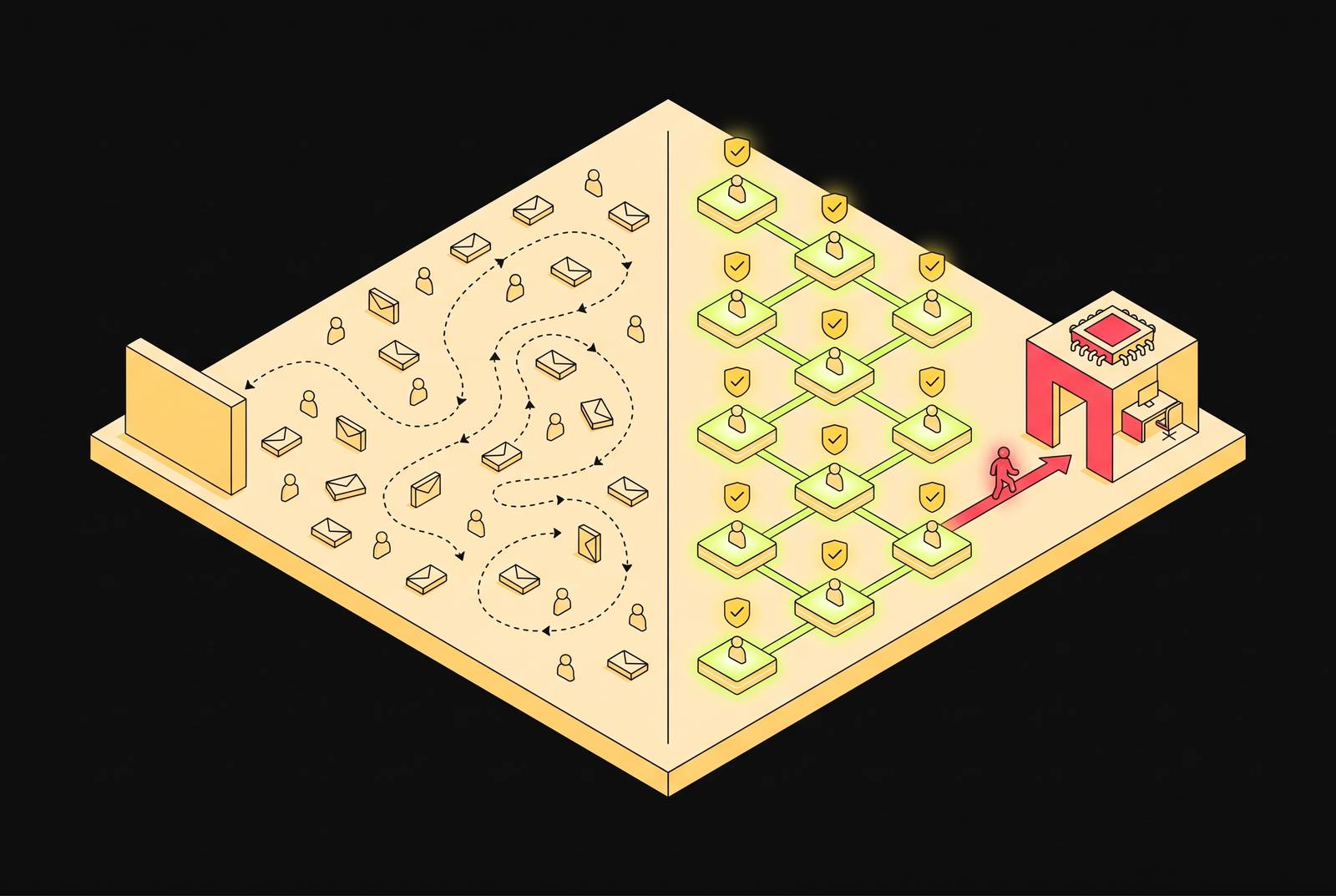
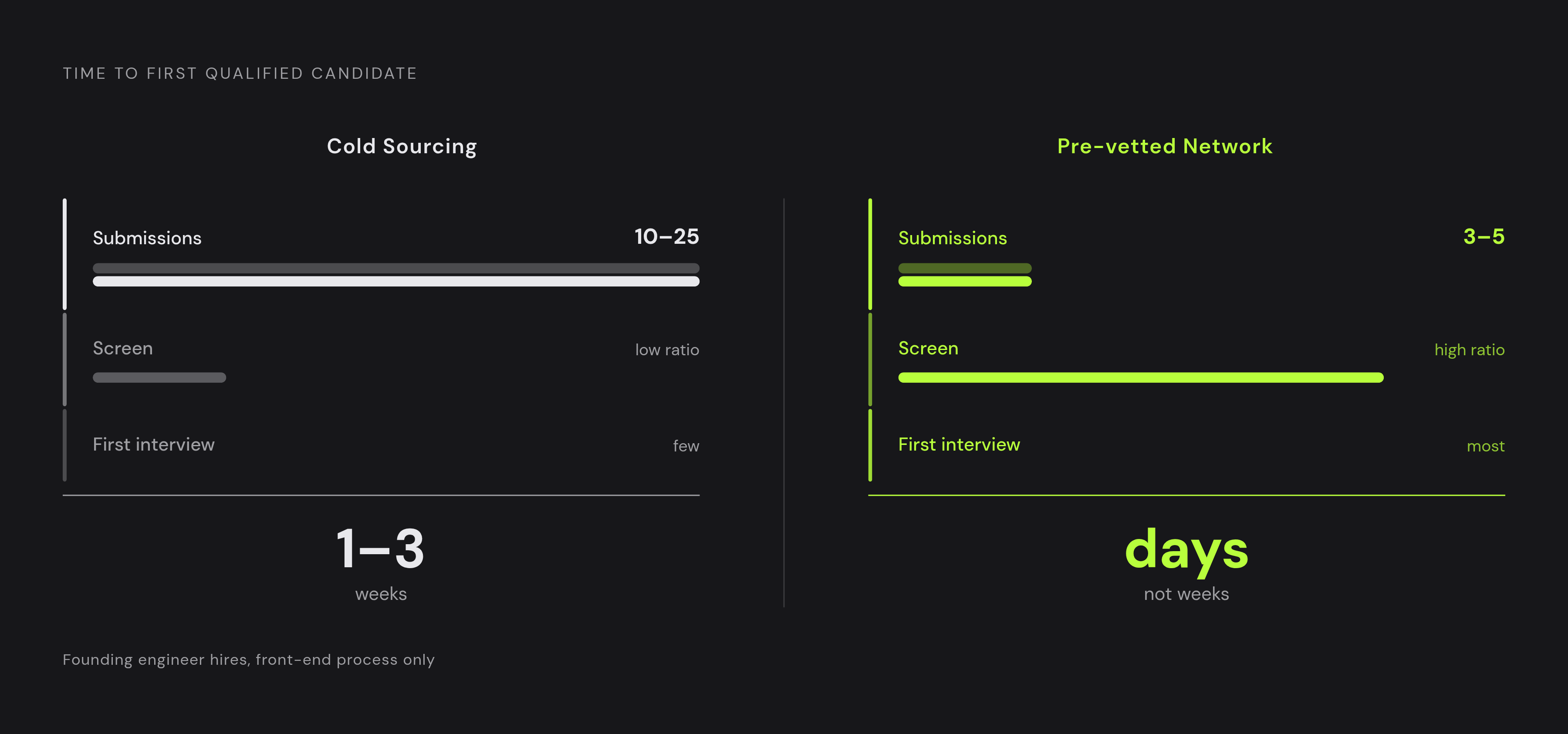
The submission funnel then becomes smaller and more useful. With pre-vetted sourcing, the founder gets three to five submissions with a high submission-to-interview ratio, while cold sourcing brings ten to twenty-five with a low ratio. Fewer profiles reach the founder’s desk. More of them warrant a conversation, so time goes toward evaluating plausible hires. Time to the first qualified candidate drops from one to three weeks through cold sourcing to within days through pre-vetted networks.
That comparison concerns the front of the hiring process. The founder still has to assess the candidate and check whether their technical skills come with the fit needed for a founding team. The client takes just as long to evaluate the candidate. The time saved comes from starting that stage sooner, with better evidence already in hand.
Why passive candidates from curated networks are a better match for a founding engineer role than active applicants
The engineers most qualified to be a founding AI hire are typically already employed and building something. They are not necessarily searching or responding to cold outreach and job listings. A curated network instead identifies and recommends them, reaching people the application process would otherwise miss. That access adds a quality advantage to the shorter screening timeline.
Engineers suited to zero-to-one work are often following technical communities and evaluating opportunities through the quality of the problem. Strong outreach requires technical credibility and a real peer-to-peer conversation.
Hunt Club illustrates how a warm introduction can work. It maps who knows whom in a network of vetted leaders and finds people those leaders already know. The candidate enters through trust, which gives the opportunity a different starting point from an unsolicited message.
A curated introduction also tends to bring more focused intent. The passively surfaced engineer was not mass-applying to a large number of roles at once, so their attention is less divided and their exit risk during the process is lower. It gives the founder a more deliberate conversation with someone considering a particular problem. For a founding role, that is more useful than application volume alone.
How do you choose a pre-vetted talent network for your first engineering hire?
A founder evaluating networks should start with the process behind the label. “Pre-vetted” can describe anything from a short phone call to a full technical assessment reviewed by a practitioner. Ask for the specific screening steps alongside the rejection rate. A firm that cannot explain either is offering no clear evidence of curation. The rejection rate is a signal of selectivity, while the steps show what the network actually knows about each candidate.
The next test is who judges the work. Establish whether a practitioner reviews the technical assessment or a recruiter reads from a question sheet. For AI roles, ask whether the assessment covers the actual deployment context, including production LLM experience, MLOps exposure, and vector database familiarity where relevant to the role. A generic software screen is not equivalent.
Ask whether the network checks who the candidate is before the final interview, because remote AI-polished profiles and deepfake tooling that is getting easier to access make it necessary to check profiles. Establish the fee structure and replacement terms. If the engineer is outside the company’s jurisdiction, establish who the legal employer will be. These are separate questions from technical quality, and a strong technical screen does not answer them.
Speed claims also need a credible explanation. Delivering three to five matched profiles shortly after a role is defined requires continuous screening. Ask how the network keeps that work ahead of demand. For a founder without a technical co-founder, the final test is trust in the underlying evidence. The vetting must be strong enough to lean on during the interview.
How the interview process should be designed once a pre-vetted candidate is in the room
Once baseline screening is complete, the founder should use the interview to test fit and decision quality. The relevant AI startup format in 2026 departs from algorithm assessments typical of large technology companies. It begins with a thirty to forty-five minute conversation with the hiring manager or founder, focused on fit and evidence of shipped AI features. The next stage is a four to eight hour take-home project building a small AI feature to specification. In a 45 to 60 minute review, the candidate then explains and defends their trade-offs.
The review is where technical choices become visible. Timed algorithm puzzles test work that AI coding assistants now solve in seconds, rather than how a founding engineer handles real constraints. Better questions ask which options the candidate ruled out, what trade-offs they made, and how time or team size limited what they could do. To test debugging, the interview should use a real failure the candidate was responsible for in place of a textbook problem. The aim is to understand how the person decides when there is no larger engineering organisation to catch a poor call.
For distributed hires, that judgment includes how they tell others about their work. A majority of AI-specific postings in early 2026 listed fully remote or remote-first arrangements. The interview should therefore assess how the candidate gives and receives feedback, communicates under ambiguity, and takes ownership without an office to smooth over gaps, even when the network has already established technical competence.
The founder must also keep decisions moving. A loop extending beyond a week or so without a clear next step risks losing a finalist to a faster process. Pre-vetting cannot compensate for an interview that stalls after the introduction. The network finds and screens candidates, while a well-designed interview loop helps turn introductions into hires. Together, they give the startup a way to make a sound first engineering hire before the candidate’s window closes.