Why Most Recruiting Platforms Still Send AI Startups the Wrong Engineers
Platforms match on the "AI engineer" label, not the work.
Most recruiting platforms send AI startups the wrong engineers because they match a broad label without identifying the specific kind of work. A curated talent marketplace for elite ML and software engineers joining AI startups needs to establish the specialization before sourcing, then assess demonstrated capability in that field. Without that design, “pre-vetted” can mean screened for a different job.
Why AI role taxonomy has fractured into seven distinct specializations
“AI engineer” reads like a searchable category to a recruiter's keyword filter. To a practitioner, it leaves the actual work unspecified. The label now covers at least seven specializations, each with different technical foundations, talent pools, and career paths. The split reflects genuine depth. As frontier models have advanced, that depth has compounded.
Classical ML engineers work on supervised learning pipelines, while MLOps engineers look after training infrastructure and deployment. Prompt engineers optimize LLM behavior, and AI safety researchers address alignment and interpretability. Applied researchers translate papers into production systems. Data engineers build feature stores and vector databases, while full-stack AI engineers bring models into the products people use. These are related disciplines, but they are not interchangeable.
Practitioners increasingly identify with these specialties and can read a generalist posting as career regression. The posting suggests leaving behind a skill they have built and leaving it unused. For startups, this changes the shape of the first team. Hiring one “AI generalist” no longer provides dependable coverage across the full stack. Startups have to choose specializations sooner, and their first teams need to be larger than those at similar non-AI engineering organizations.
How recruiting platforms collapse that taxonomy into a single keyword match
Most recruiting platforms flatten those distinctions into shared keywords. A match on “Python” or “LLM” does not establish whether someone has built data pipelines, trained models, or shipped production APIs. Yet the matching system can treat those signals as the same. Stack context, adjacent skills, and evidence of seniority disappear. The failure starts in the product's design, before a recruiter makes a judgment.
Consider a senior ML engineer experienced in transformer architectures, distributed training, and production inference. That person is not the same hire as a machine learning engineer who spent two years fine-tuning scikit-learn models. Both can appear under the same label. A platform that cannot represent the difference has no reliable basis for matching either person to the right opening. More profiles do not repair the missing distinction.
The strongest technical recruiting software can parse stack context, recognize adjacent experience, and assess seniority beyond a title. Most platforms do not reach that standard for ML, data, and applied AI roles. Researchers, applied ML engineers, and MLOps practitioners work on different problems and come from different groups of people in the field. The job description exposes the same weakness. When the matching logic has no useful way to specify the specialty, “AI engineer” becomes the input as well as the output.
What arrives when the taxonomy match fails — the three-tier candidate problem
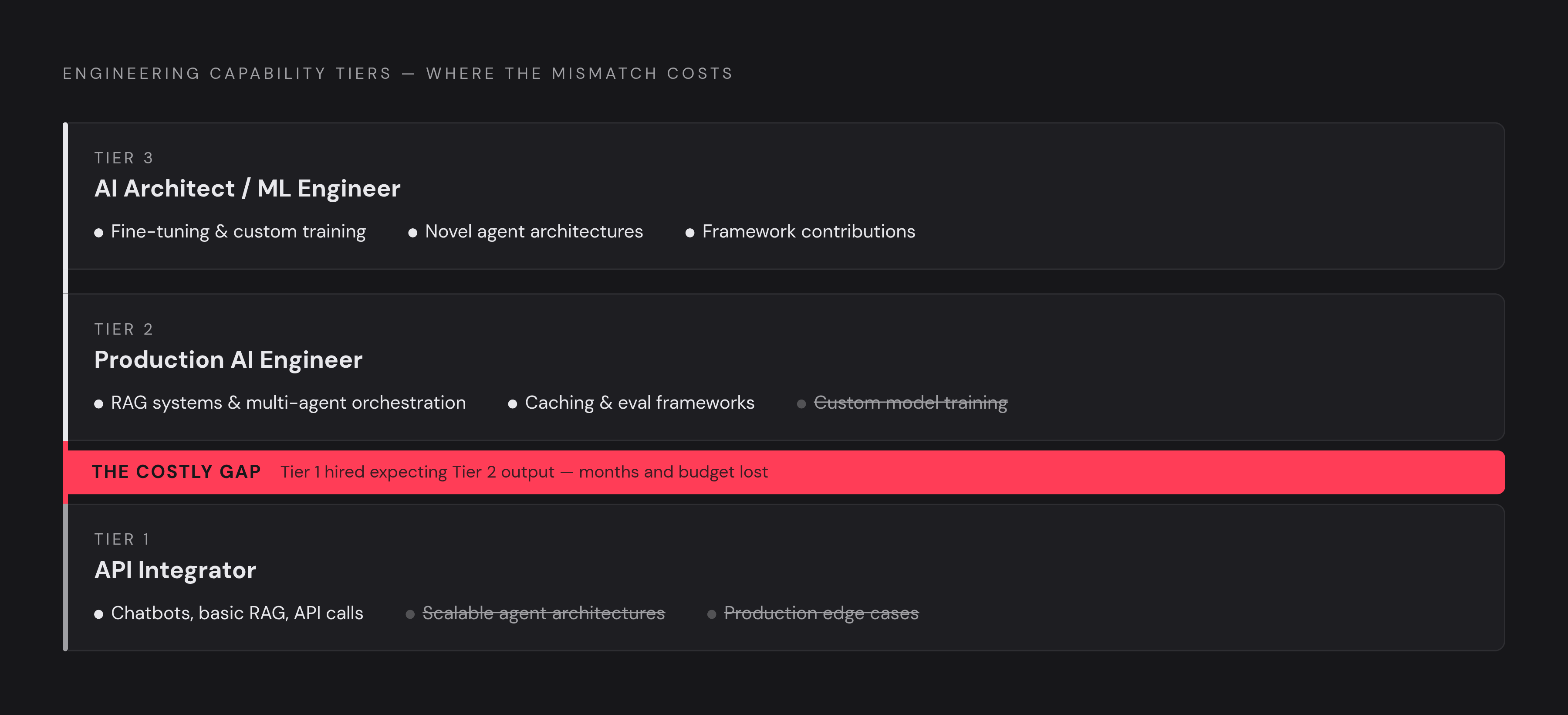
The resulting mismatch becomes clearer through three tiers of engineering capability. Tier 1 API Integrators can connect OpenAI or Anthropic APIs, build chatbots, and implement basic RAG with off-the-shelf tools. Their limits emerge beyond that initial integration. They cannot design scalable agent architectures, optimize inference costs at scale, or handle production edge cases. A demo that works does not show that someone has those skills.
Tier 2 Production AI Engineers can design and deploy RAG systems, build multi-agent orchestration, and implement caching, fallbacks, and evaluation frameworks. They do not cover custom model training, novel architectures, or research-level problems. Tier 3 AI Architects / ML Engineers can also do fine-tuning, build custom training pipelines and novel agent architectures, and make framework contributions. Research ability alone is not the same thing. ML researchers who do not ship production systems belong to a different hiring question.
Teams often make the costly mistake of hiring Tier 1 and expecting Tier 2 work. Connecting an API does not demonstrate command of context window limits, chunking strategies, re-ranking, or citation accuracy in production RAG. The gap can consume months and substantial budget. A related mismatch places an engineer in a research seat, producing a wrapper around somebody else's paper, or a researcher in an applied seat, doing careful work against a fast metric before leaving for a lab. Keywords conceal both the capability gap and the difference in purpose.
Why the supply side makes keyword matching even less reliable
An estimated 300,000 practitioners across the world have the skills to do production-grade ML engineering. They face demand from incumbents reorganizing around AI-first strategies and venture-funded AI-native startups at Seed and Series A. The strongest candidates are generally not looking for work. Proven production experience is scarce, and much of it sits outside the applicant pool.
These candidates consider a move when total compensation, including cash and equity, clears their risk-adjusted threshold. Mission, technical direction, and equity structure also shape the decision. An inbound platform sees a different population. Its applicants skew toward Tier 1 because Tier 2 and Tier 3 engineers are already employed at well-funded companies and are not submitting applications. That limits what application volume can establish.
So nearly every search for a strong hire needs passive outreach. This makes precision more important. The pitch has to connect a specific opportunity with the work someone already knows how to do. A generic opening gives a passive candidate little reason to enter the process. Getting the specialty wrong can lose the candidate before an interview has a chance to expose the mismatch.
How compressed decision timelines punish platforms that get the first match wrong
Candidates are managing several hiring processes at once, while AI startups see talent acquisition as zero-sum competition. Decisions have compressed to two-to-three weeks from first contact to offer acceptance. There is little room for a false start. By the time an interview reveals that the platform matched the wrong specialty, competing processes are already moving.
That shorter window leaves founders much less time to feel sure of a hire through technical assessments and talks about how well the candidate fits the team's culture. The team may agree on a hire only after the candidate has accepted another offer. Speed also becomes a signal of intent. Candidates notice how fast founders answer technical questions, whether they can do the interviews in a single-day onsite visit, and whether they get an offer within days of the last interview.
A founding engineer search already stretches across weeks to months, depending on stage, compensation, and the founder's ability to sell the vision and equity credibly. A bad first match pushes the search toward the longer end. A founding engineer who can build LLM wrappers but cannot build evals can leave a product that works in demos and fails in production, poisoning subsequent hiring. Fixing that choice requires a second search.
What pedigree-first screening does and does not solve
It makes sense to filter for people who have worked at research labs when keywords say so little. A majority of engineers who pass through top platforms previously worked at OpenAI, Anthropic, Google DeepMind, or Meta AI. Those affiliations provide a narrower starting point than an unrestricted keyword search. They are not proof of the required capability.
The stronger signal is scarce, hard-to-fake work, such as leading a large training run, showing depth in reinforcement learning, or authoring a model people actually use. But its relevance still depends on the role. A platform has to name the specialization it is hiring for before it can judge which skills are worth paying more for. Pedigree provides a shortcut that leaves that decision unresolved.
The filter also narrows an already difficult supply pool because lab-affiliated engineers are among the least likely to apply. Applied to inbound traffic, it seeks the right label in the wrong population. xAI offers a different approach to defining roles. In July 2025, Elon Musk said the company was deleting the researcher/engineer distinction, calling “researcher” a relic from academia. One engineering standard with shared accountability for what ships is a deliberate taxonomy decision.
How can AI startups find pre-vetted ML engineers who actually know their stuff?
OpenAI has moved its coding round from abstract algorithm puzzles toward questions about how to solve problems in practice. A round is usually like working through a real problem in a shared Python editor such as CoderPad. The assessment targets engineers who can build for production environments at frontier scale. The job's demands determine the test. That is what resolving the taxonomy upstream looks like in a hiring loop.
Canva replaced its Computer Science Fundamentals screening after it found that AI tools gave correct, well-documented answers in seconds. Its new format expects AI tool use and presents problems a single prompt answer cannot resolve, requiring iterative thinking, clarification of requirements, and sound decisions. Shopify gives candidates an empty GitHub repo, their own IDE and AI tools, and a task to build from scratch over screen share without starter code. The formats differ, but the design principle is shared. Each makes the intended kind of work explicit in the assessment.
For startups and platforms, the practical lesson begins with the job description. “Senior Software Engineer, AI Products” and “Founding Engineer, LLM Infrastructure” identify different work more clearly than “AI Engineer.” Specificity helps attract shippers and discourages paper-writers between research positions from applying. The title should express the work the team has already decided it needs before interviews begin.
Evaluation then has to test that same work. Platforms that explicitly score LLM debugging workflows, MLOps tooling, and RAG architectures distinguish AI-native engineering skill from recent exposure to AI tools. A candidate's history of production deployment says more when they can explain specific failure modes. Inference-cost awareness and evaluation framework design add evidence that resume keywords cannot supply. For a senior ML hire, “pre-vetted” is useful only when the buyer knows which of these capabilities was assessed and how it fits the opening.
Why the mismatch will persist until platforms treat taxonomy as a first-order product requirement
Platforms built to hire generalists before AI have added AI filters to the keyword systems they already had. That infrastructure assumes candidate profiles and job descriptions share a common vocabulary. Here, the assumption breaks. Practitioners and employers can use the same words for different work, so a later filter cannot reliably recover distinctions the original match discarded. The specialty has to be part of the matching architecture.
Generalist fractional recruiting faces the same limit when the recruiter lacks deep technical networks in ML infrastructure or AI safety. Without that knowledge, production experience can be difficult to distinguish from resume-shaped claims. Paying by the hour does not close the gap. Open marketplaces also find volume and speed easier to optimize than specialization depth. Being paid for time or for a placement does not by itself reward taking the time to pin down the right specialty.
The alternative establishes which specialization is needed before sourcing begins, finds candidates through outreach and referrals rather than waiting for applications, and matches demonstrated capability to the specific field. Engineers gain from that precision too. They can be found for work that fits their actual experience, with salary bids upfront and without process theater. Their production ML history need not compete as a keyword equivalent of someone's brief exposure to LangChain. The companies winning top AI engineering talent in 2026 signal that they already know what they need and can evaluate it without wasting a senior engineer's time.