How a Two-Person AI Startup Closes a Senior Engineer in Weeks Not Months
Speed matters most when competing for senior talent you can't outpay.

For technical founders making the first engineering hire at a two-person AI startup, the fastest route is a narrowly scoped role, direct outreach to passive candidates, and a three-stage interview loop built around real work. Prepare calendars and offer terms before outreach starts. The goal is a signed offer inside the median 23-day dropout window, without cutting the evidence needed to make a sound hire.
Why a two-person AI startup faces a structurally different hiring problem than any other employer
A founding engineer needs Staff+ technical ability and the product judgment to build AI systems that hold up in production. That is a distinct hiring lane. The team is smaller, but the bar is higher. Seed startups in 2026 are closing funding rounds with teams 23% smaller than the 2021 cohort, while AI tooling has raised the output expected from each engineer.
Competition makes that combination harder to find. AI-native startups and frontier labs absorb most of the senior supply, leaving a thin middle market for everyone else. A seed-stage company cannot match what those employers pay senior AI and ML engineers dollar-for-dollar. Yet the first hire’s architecture choices can persist for years, and their working style shapes the engineers who follow. The one lever a small team actually controls is speed.
How do you hire your first senior engineer when the standard search takes months?
A search led by a founder usually takes five to six months. Several weeks go into defining the role and sourcing strategy, followed by two to three months of outreach and screening. Interviews take another four to six weeks when meetings are hard to schedule, and negotiating an offer can add weeks while candidates weigh other offers. Most of the search passes before a strong candidate is seriously engaged. The company’s clock and the candidate’s clock are different.
Think of a founder who loses a finalist on day 31. The founder may see a reasonably quick month of interviews, but the candidate has already passed the median 23-day dropout window. At decision time, a finalist typically has multiple active offers. For top candidates, the availability window can be just 10 days, so even a 23-day search needs room to accelerate an individual decision. Less than one in ten senior AI engineers updates their LinkedIn profile in any given 90-day window. Waiting longer does not produce a dependable fresh pool.
Scoping the role correctly before sourcing starts, to avoid two months interviewing the wrong people
The first compression decision happens before outreach. Hiring for the wrong AI profile is the most common reason a founding search runs three months longer than it should. If the model exists but the product does not work reliably for users, the target is an AI engineer. That person owns the customer-facing capability through model APIs, retrieval, agents, evaluation, and product judgment. For a two-person team before product-market fit, this is almost always the right profile.
If model performance or production scale is the bottleneck, the target shifts to an ML engineer who trains and serves custom models, working in tools such as PyTorch and MLflow. A research scientist is the right choice only when defending the business depends on solving something that established methods cannot solve. That is rarely the right first hire. Candidates can move fairly readily between AI engineering and ML engineering, but movement into or out of research engineering is much rarer. Those distinctions should narrow outreach.
The practical rule is to stay API-first until product complexity outgrows that layer, a data advantage demands custom retrieval or fine-tuning, or a competitor’s model capability becomes a moat. Write the profile around the actual bottleneck. For an AI engineer in 2026, agentic workflows and advanced RAG architectures are table stakes. The brief should require fluency in LLM application architecture, retrieval pipelines, agent orchestration, evaluation and observability, and cost/latency engineering. It should also make clear that the engineer must move between infrastructure, product code, and data modeling.
Where to source candidates who will never appear on a job board
A job posting is not a sourcing strategy for this hire. The candidates a two-person startup wants are usually passive. Direct outreach to people at top AI companies is therefore a better starting point than waiting for applications. A large response count does not compensate for a poor match to the role.
Series B companies offer another useful pool. Their engineers may have scaled systems successfully but now spend their time in middle management or incremental maintenance. That background can combine technical depth with the operational maturity a founding role needs. Other relevant candidates include former startup or big-tech engineers who want to return to startup work, and engineers at startups who are quietly open to another one. These are reasons to start a conversation while someone’s willingness to leave remains uncertain.
The opening message should bring a specific observation about the product or what needs to be solved. Explain what the engineer would own and why the work is genuinely hard. Then describe what they would have built within a year. Specificity gives a passive candidate something concrete to evaluate. It also starts the conversation on the same ground the interviews will test, rather than spending the first call discovering whether the role fits.
Interview design that signals seriousness without adding rounds
For a two-person team, interview design is a product decision. It shows whether the company values useful work, clear judgment, and the candidate’s time. A three-stage, work-sample-first loop evaluates the job more directly than a multi-round panel process. The founder’s task is to choose the evidence each stage must produce. Extra rounds are not a substitute for that choice.
The initial screen should be a short founder conversation about the specific AI problem. Its purpose is to test genuine curiosity about the domain. The hands-on technical session then asks the candidate to design a proof-of-concept architecture for the company’s actual problem. The discussion should cover RAG design, how to measure quality, what the evaluation dataset looks like, and cost per query. This makes technical judgment visible in the work itself.
The final founder conversation should test scope and restraint. Ask what the engineer would not build in the first months. Strong founding engineers know what to leave out when time and resources are tight, while candidates who try to fit everything in are a warning sign. Across the loop, look for demonstrated interest in the problem and evidence of shipping real things end-to-end under ambiguity. Generic interview performance is not the same evidence.
Skip algorithmic coding screens, which take more time without showing well how someone would do in this role. If a take-home is used as the technical work sample, keep it paid and bounded at four to eight hours, with compensation of $300–$1,500. It belongs within the technical stage. Paying for that time expresses the working culture being offered. A shorter process should cut work that has little to do with the job while keeping the evidence needed to make the hire.
How to pitch a founding engineer role when you can't win on compensation alone
The pitch should lead with the work. Strong AI founding engineers are evaluating whether the problem is authentic, whether the founders understand it technically, and whether proprietary data or a unique framing provides a defensible advantage. They also want to know whether they are early enough for the equity grant to count and whether they will build or spend their time creating processes to build. These are concrete questions. A broad promise of ownership leaves too much unanswered.
What is said should match the outreach and technical session, but the offer conversation needs to clear up any doubts the candidate still has. Explain the product stakes of the work they have now discussed. Name the equity range explicitly and early. Pre-seed base salaries and seed-stage ranges are meaningfully below frontier-lab pay, so founding-engineer equity changes the total outcome calculation. Grants at the 75th and 90th percentile are particularly relevant to that comparison.
A written equity refresh commitment should appear in the first offer as a default term. Its inclusion correlates with 30 percent fewer counter-offer accepts and signals long-term alignment. Speed cannot rescue an AI problem that is not compelling enough to attract the engineer. If the team has not validated the problem, a polished process cannot substitute for a real reason to join.
Scheduling and decision cadence — where most compressed processes still bleed time
A three-stage loop can still take six weeks if every meeting has to wait for free time in the founder’s calendar. Founder-led interviews within the first five business days of contact correlate with a 2.1x higher offer acceptance rate. Early speed communicates that the role is a priority. Set aside time for interviews before sourcing begins so there is no scramble after a candidate replies. Move from initial contact to the first technical session within five business days.
After each stage, debrief and advance or decline promptly. Candidates read slow feedback as low interest. Define and approve offer terms before the final conversation so the offer can follow quickly, rather than starting an internal negotiation after the candidate has finished interviewing. This is where preparation turns into elapsed time saved.
The Bay Area hosts most frontier AI talent, while New York City, Seattle, and Washington D.C. absorb most of the remainder. Remote-first startups outside major hubs are losing more finalists to in-person mandates, so the team should decide where it expects people to work before negotiating an offer. The same advance planning applies to the period after acceptance. A senior engineer joining a seed-stage startup needs several weeks to get fully up to speed, so define what success in the first quarter looks like before the offer goes out and allow for that ramp-up time in plans for day-one productivity.
Assembling the full timeline: what a 23-day founding engineer close actually looks like
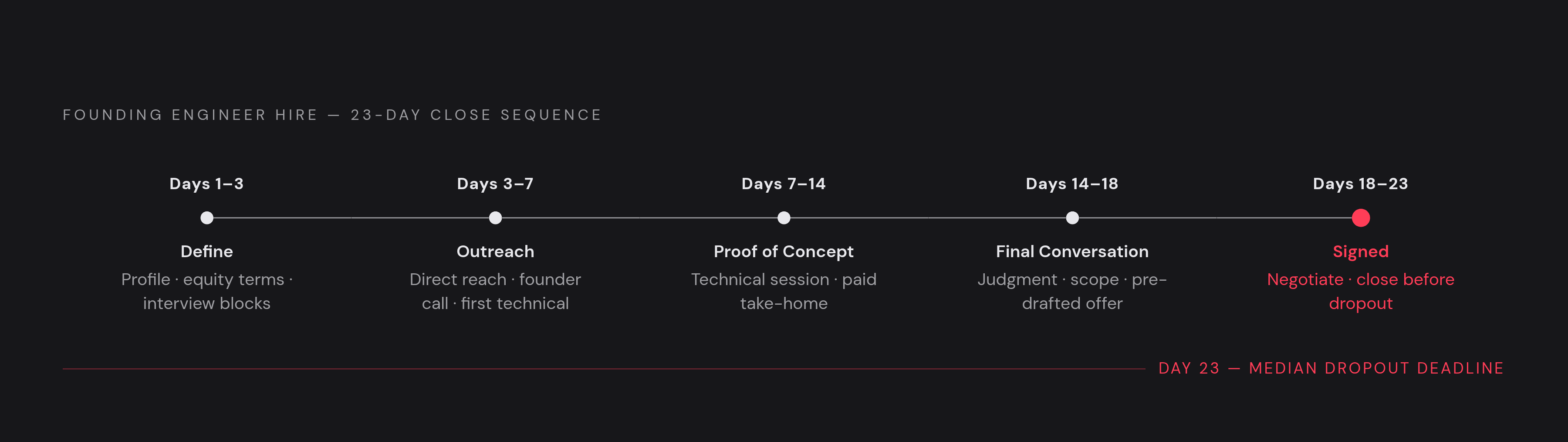
Days 1–3 are for removing decisions that would otherwise interrupt the search. Choose the AI engineer or ML engineer profile, write the job brief, approve the equity terms and the bounds of the offer, and set aside time for interviews. Set the location stance and first-quarter success criteria during that preparation. No candidate should have to wait for those decisions. The preparation is what makes the later schedule credible.
Days 3–7 are for direct outreach to passive candidates and the first founder conversations. Schedule those conversations within five business days of contact, and hold the first technical session within the same window. The dates are not waiting periods. A candidate reached early should move through the steps early, and someone with a 10-day availability window needs to move faster than the timetable for the whole search.
Days 7–14 are for the technical work, including the proof-of-concept discussion and a paid take-home where used. Communicate decisions promptly rather than holding feedback until the end of the week. Days 14–18 are for the final founder conversation on judgment and scope, followed promptly by the already-drafted offer. Keep the written equity refresh commitment in that first offer. Days 18–23 are for negotiating and aiming to get a signed agreement before the median dropout clock runs out.
This sequence makes a 23-day close achievable. Searches led by founders that close inside six weeks win 2x more often than twelve-week searches, but they gain that edge by cutting time spent waiting while still getting the evidence needed for a decision. The candidate still sees the problem, does technical work on it, and tests what the role will cover. In return, the founders demonstrate how they prepare, decide, and respect time. The hiring process is the first product the engineer sees.