What ML Engineers Get Wrong When Reading a Series A Equity Package
Fully diluted ownership and exercise costs matter far more than the equity percentage itself.

For ML engineers evaluating Series A and Series B AI startup jobs, equity percentage is not enough to compare offers. A Series A package becomes readable only when the fully diluted ownership, strike price, post-money valuation, dilution path, and refresh policy are clear. Depending on the exercise window, keeping that equity could require cash long before it produces any.
Why ML engineers anchoring on equity percentage are asking the wrong first question
When the offer arrives, the engineer spots the equity percentage and starts judging the offer by that number. The rest of the agreement starts to look like paperwork. That reaction follows the way offers are presented. The percentage gets top billing, while the terms that shape its value are elsewhere or left out of the offer letter altogether.
At Series A, this creates a particularly bad comparison. The company already has a high valuation, so a small difference in ownership can mean a large difference in dollars. But those dollar figures say little without knowing what the engineer must pay to exercise and who owns what behind the grant. A percentage can look generous while the economics are not.
The natural objection is that percentage is at least a starting point. It is not a reliable one by itself. Two grants with identical percentages can differ by several hundred thousand dollars in actual value depending on the 409A valuation and cap table structure. The first task is therefore to establish what the number measures.
What a Series A equity percentage actually represents on a fully diluted cap table
An equity percentage needs a denominator to mean anything. The comparable denominator is fully diluted shares outstanding. A raw option count cannot tell an engineer where the grant sits in the company’s ownership. Without the total share count, it is an incomplete number.
Fully diluted ownership includes issued shares, outstanding options, and options authorized but not yet issued. It also includes warrants, convertible preferred stock on an as-converted basis, SAFEs, and convertible notes. The option pool belongs in that calculation too, including any pool the company has just created or topped up for the hire. Leaving those claims out makes the engineer’s share look bigger than it is.
The practical request is specific and short. “Can you give me my grant as a percentage of fully diluted shares outstanding?” That asks the company to put the grant on a comparable basis rather than leave the candidate to interpret a share count. It also brings the pool into view before the engineer starts attaching dollar values to the offer. At this stage, the question concerns measurement.
How the 409A valuation and strike price shape what the grant is actually worth today
The strike price is what the engineer pays per share to exercise the options. That cost comes before any gain from ownership. Section 409A of the tax code requires a grant’s strike price to be at or above the fair market value of common stock on the grant date. A below-market grant can create immediate income tax and a substantial penalty for the recipient.
The 409A valuation establishes that common-stock value, which is different from the price investors pay for preferred shares. Common stock does not have the liquidation preference, anti-dilution protections, and other rights that come with preferred stock. Early-stage companies therefore typically have a material discount between the two. When the 409A sits close to the preferred price, the grant has much less room between its exercise cost and that fundraising reference point.
The questions to ask are the current 409A valuation and the price of the Series A preferred shares. At exercise, the relevant spread is between the strike price and the then-current fair market value of common stock. A valuation on paper is not cash received.
Timing also changes the calculation because companies must update their 409A after material events such as funding rounds. A grant issued shortly after a large Series A may have a higher strike price than one issued a year earlier. The valuation itself may not be negotiable. Knowing it still lets the engineer work out the exercise cost, value the grant against the post-money valuation, and keep that paper figure separate from what the grant could earn.
Where Series A ML engineer grants actually sit in 2026, and why pre-2024 benchmarks are the wrong reference
Series A AI/ML equity grants have risen materially since 2024. Older benchmarks can therefore understate what a competitive offer looks like in 2026. The useful comparison depends on when the engineer joins and what they are being hired to own.
Employee number 3 building the core model is not in the same market as employee number 25 building on top of it. Proximity to core intellectual property is the primary driver of where a grant lands within its range. An engineer responsible for model architecture and one responsible for MLOps infrastructure can receive different grants despite matching titles and seniority.
There is also a limit to what historical founding-hire stories can establish. The large 2021-era grants have largely disappeared, and the realistic upper range for a founding hire joining at seed is now 1–2.5%. Series A founding hires sit materially below that. The seed range is not a Series A benchmark.
These distinctions provide calibration. Once that comparison is sound, the next question is how much of the initial ownership survives future financing.
How dilution across subsequent rounds erodes the percentage an engineer accepts today
The percentage accepted at Series A is not fixed through exit. Each subsequent financing round dilutes existing ownership. Series B and Series C each reduce the stake left by the round before, so the reductions compound. An offer valued as though the original percentage survives untouched overstates what the engineer is receiving.
Growth in the option pool also adds dilution. Investors typically require the pool to be topped up before the new money comes in, which places that reduction on existing shareholders, including the engineer. The financing headline does not explain the whole change in ownership. The pool increase has to appear in the calculation too.
A useful model starts with the fully diluted grant percentage and works out the Series B and Series C dilution the company expects. It then includes expected pool increases to show the percentage that could reach a liquidity event. The result will be materially smaller than the offer-letter figure. What the stake left after dilution could be worth also depends on the company’s value, so dilution alone cannot tell the engineer whether to take the offer.
The question for the company is direct. “How many rounds of dilution does the company anticipate before a liquidity event, and what does that do to my percentage on a pro-forma basis?” A transparent answer exposes the assumptions behind the pitch. It also gives the engineer something more useful than a future exit value multiplied by today’s ownership percentage.
What the post-termination exercise window means in tax and practical terms, and why it's the clause most engineers don't read
Suppose the engineer leaves in year two, before any liquidity event. With a 90-day post-termination exercise window, an engineer who leaves may have to decide almost at once whether to spend the cash to exercise the vested options. The engineer must pay to exercise into illiquid shares or walk away from the options when they expire.
The tax rules make the deadline more consequential. IRC 422(a)(2) requires incentive stock options, or ISOs, to be exercised within a short period after termination to retain their favorable tax treatment. If the plan allows an extended window, unexercised options convert to non-qualified stock options, or NSOs, after that period. The full spread at NSO exercise is taxed as ordinary income.
Some companies offer windows of up to 10 years. That gives the engineer more time to decide, but ISO treatment still ends. The ISO-to-NSO conversion still happens on day 91.
The question to ask is therefore both contractual and tax-related. “What is the post-termination exercise window, and are these ISOs or NSOs?” Some companies issue NSOs from the start to support extended windows without the ISO complexity. ISO holders who exercise in a year with a high spread may also owe alternative minimum tax, so engineers with higher incomes should understand the AMT exemption phaseout before working out what an exercise would cost.
The refresh policy, vesting schedule, and double-trigger clause that determine whether the grant holds its value over four years
The initial grant does not describe the whole four-year package. Vesting sets when the engineer earns the options, while refresh grants add equity after the first award. Without a refresh, an engineer who stays past the cliff can see their ownership erode relative to later hires receiving new grants.
“What is the refresh policy after the cliff — is it automatic, performance-triggered, or discretionary?” Those are different commitments, even if a recruiter describes all of them as opportunities for more equity. A company with no stated policy is not showing a concrete plan for equity-based retention.
Acquisition protection is a separate part of the agreement. With double-trigger acceleration, unvested equity vests only when there is both an acquisition and an involuntary termination. Single-trigger acceleration is typically reserved for co-founders and C-suite executives and can complicate acquisition negotiations.
All of these terms still depend on an actual grant. An offer letter is not the grant itself. Options need board approval and a 409A-backed strike price to be legally binding. Even a clear promise of equity, spoken or written, needs board minutes and a formal grant agreement before the award is complete.
How should an ML engineer evaluate a Series A package? The five questions that surface the real offer
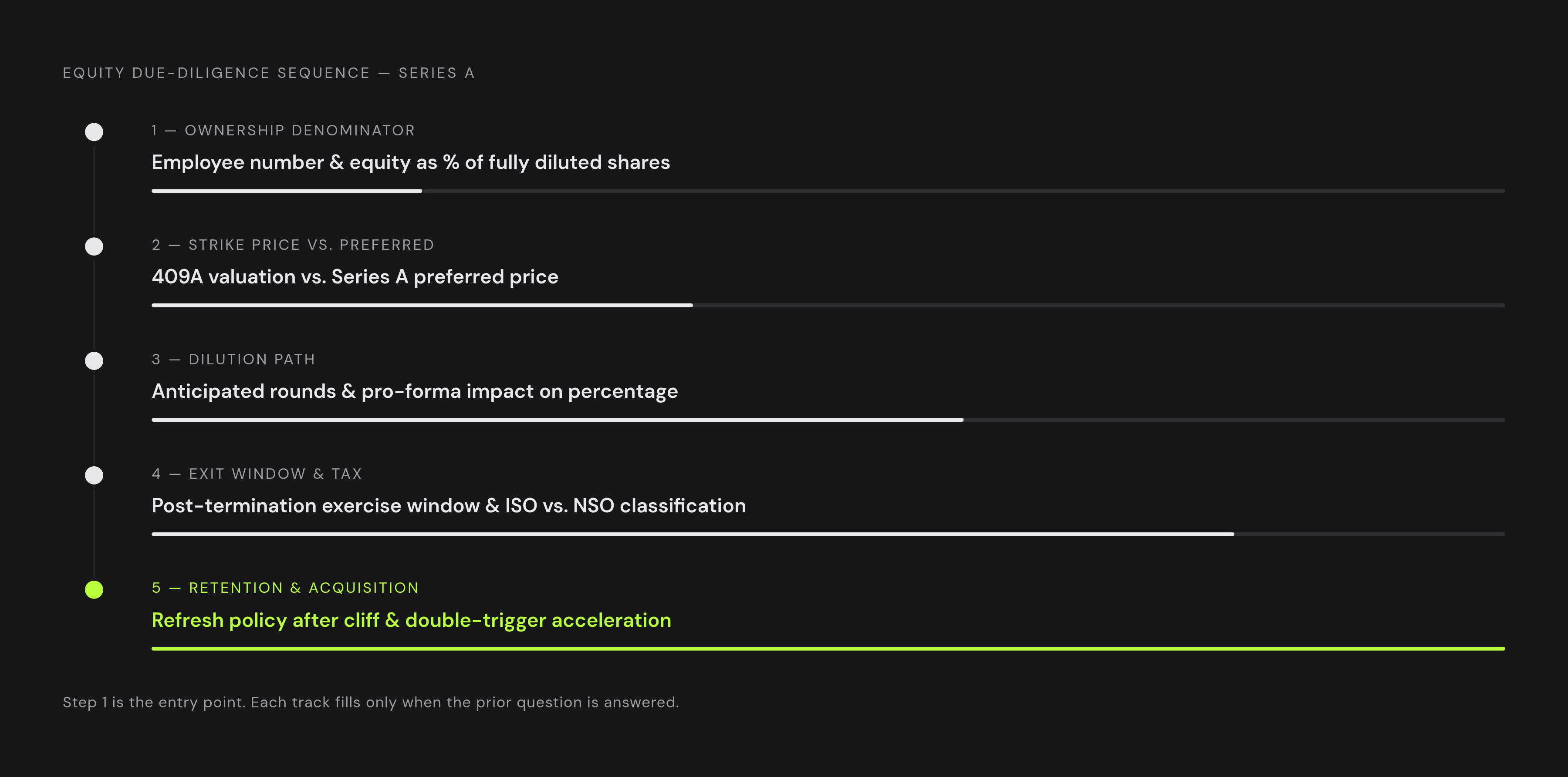
The evaluation can now become a sequence of five questions. First, “What employee number am I, and what is my equity as a percentage of fully diluted shares outstanding — not just authorized shares?” This establishes both the role’s context and the denominator. It prevents a founding-hire label or a large option count from standing in for comparable ownership.
Second, “What is the current 409A valuation, and what did the Series A preferred shares price at?” Third, “How many financing rounds does the company anticipate before liquidity, and what does the pro-forma dilution do to my percentage?”
Fourth, “What is the post-termination exercise window, and are these ISOs or NSOs?” Fifth, “What is the refresh policy after the cliff, and is double-trigger acceleration included?” These questions cover leaving, staying, and being acquired.
A company unable to answer is providing useful information too. Its equity offer has not been explained well enough to evaluate. For engineers comparing two to four active packages, a clear explanation can distinguish one offer from another. Negotiation effort is finite, and spending all of it on base salary leaves the equity structure untouched, even though equity may be the larger component in a successful outcome.
The decision still needs a sober limit. Even a well-structured grant at a well-funded Series A company is a long-odds bet. Treat equity as meaningful asymmetric upside on top of a compensation package already worth taking on its own.