Reading an ML Engineer Offer as a Data Problem Across Funding Stages
A guide to weighing salary, equity, dilution and liquidity at each startup stage.

Reading an ML engineer offer as a data problem means comparing base salary, equity percentage, strike price, dilution and liquidity. At Series A and Series B AI startups, higher cash and smaller grants do not remove the complexity of options. The right comparison starts with the actual role, adjusts for funding stage and models what the equity could become.
Why the salary line is the least useful number in an ML offer
An engineer can compare two numbers without asking about share prices, future funding or an exit. But that ease creates an anchor. Salary is the most stable variable in the package and the least useful one for explaining the spread in potential value. Equity is where offers diverge, yet it is also the part many engineers are least equipped to read.
Reading only the salary line is like fitting a model on one feature. The missing inputs can change the conclusion. A larger grant may require more cash to exercise, suffer more dilution or have a less credible path to sale. Funding stage gives those inputs their context.
Role title confusion that puts the engineer in the wrong benchmark before negotiations start
A stage benchmark is useless if it describes the wrong job. The first ships models into production, while the second bridges research and product. A Research Scientist develops new methods, and an MLOps Engineer is in charge of training and serving infrastructure. One job title can hide four different pay bands.
The mismatch can lower the budget before negotiations begin. Model-training work placed under “AI engineer” rather than “ML engineer” or “research engineer” can put a candidate in a lower band. Most Series A and Series B AI startups need a research engineer rather than a pure research scientist, unless research output is itself the product, as at a foundation model company. A posting that mixes signals from all four roles suggests the company has not decided what the work is.
Infrastructure work needs its own benchmark, too. Kubernetes, serving infrastructure and evaluation tooling belong to a distinct and scarce hiring category. Accepting the generic benchmark can surrender pricing power. The practical step is to confirm the role category before the first technical screen, because changing it at the offer stage is structurally difficult.
How funding stage systematically reshapes every variable in the offer
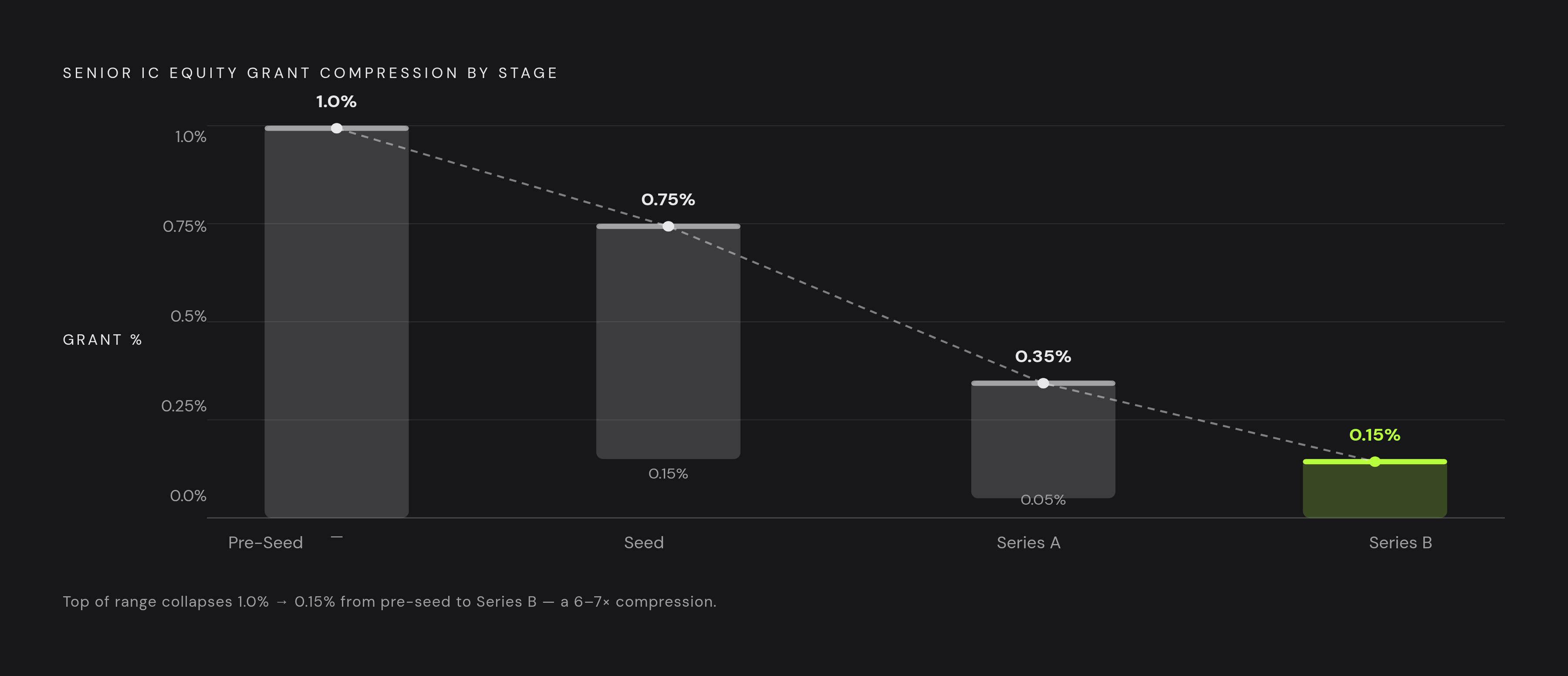
Funding stage is the biggest structural lever on the package. It shapes the balance between cash and equity, the equity instrument, the company size behind the percentage and the plausible route to liquidity. Companies at earlier stages offer a larger share of ownership with less cash, while those at later stages tend to offer smaller stakes and higher salaries. The cash premium is concentrated at senior levels.
The benchmarks calibrate that pattern. Senior IC equity runs up to 1.0% at pre-seed, 0.15%–0.75% at seed, 0.05%–0.35% at Series A and up to 0.15% at Series B. Principal/Staff AI Engineer grants run up to 1.0% at seed and up to 0.2% at Series B. Role scope still has to match the comparison.
Ownership and paper value can move in opposite directions. A 1% pre-seed grant may ultimately be worth less than a small Series C grant at a company with significant revenue and a credible exit path. The denominator is part of the bet. Series A and Series B grants are usually options, which require payment of a strike price to own shares, while Series C and later grants are more often RSUs.
What pre-seed and seed offers actually look like as a bet
At pre-seed and seed, base pay is below market and equity percentages are at their largest, but there is a high risk that the equity will be worth nothing. It is a probabilistic bet on the company. Vela Partners’ analysis based on a company database supports the broad picture that roughly two-thirds to four-fifths of seed-funded startups do not reach Series A. An ownership percentage alone says nothing about that survival risk.
The stake can also shrink before any exit. More funding and option-pool expansion dilute the original grant, so today’s percentage can give a poor estimate of how much the engineer will own in the end. Two seed offers with the same headline percentage can leave an engineer with different stakes by Series B. A larger planned pool or a more aggressive refresh policy can change the outcome.
The “founding engineer” title does not settle the price. First-engineer grant benchmarks on a four-year schedule belong to a specific hiring position. A rational seed offer therefore depends on more than the fraction offered. Technical ownership, proximity to the founders, influence over decisions and the genuinely difficult parts of the product all belong in the evaluation.
How should an ML engineer compare Series A and Series B startup offers?
Compared with seed, the company has traction, base pay is higher and the risk of total loss is lower. The package looks easier to judge. Yet moving from Series A to Series B typically does not remove the exercise decision, strike price exposure or tax complexity. A smaller percentage is not evidence of a simpler grant.
For career opportunities at these stages, role fit remains the first filter. A research engineer role should be judged against that work, rather than against a pure research scientist title with different expectations and an equity band to match. After that, the comparison turns to the option terms. The post-termination exercise window determines how quickly departure can force a cash decision, while ISO tax exposure can make exercise costly before there is a way to sell.
Refresh policy adds another forward-looking input. A written policy provides a basis for assessing how the stake may be maintained or grown. A verbal promise does not. Its absence is useful information in itself. A Series A versus Series B comparison should therefore combine role scope, cash, current grant terms and the written approach to future grants. Looking only at the smaller Series B percentage misses the mechanics that can change its actual value.
What Series C and later offers trade away and what they deliver instead
At Series C and beyond, the dominant instrument shifts from options to RSUs. The engineer no longer has an exercise decision, and RSUs are treated as ordinary income when taxable. This removes a major source of complexity. Ownership percentages are smallest at this stage, but paper value may be highest because the company behind the fraction is larger. The trade is less lottery-style upside for a structurally lower-risk form of equity compensation.
Cash also becomes a stronger part of the offer. Base salaries are highest at this stage, so the package may function as a high-cash job with real but bounded equity upside. Liquidity becomes the central unresolved question. Private-company equity cannot be treated as spendable cash simply because it has a quoted value, and the engineer needs to understand the realistic IPO or acquisition timeline and whether a secondary market exists.
Beyond the percentage’s competitiveness, the offer depends on whether the liquidity path is credible, what the base covers while waiting and whether the expected RSU value justifies the implied discount against public-company RSUs. That changes the emphasis of the analysis. It does not remove the need to inspect the underlying terms. Across all stages, a few mechanics separate a quoted grant from money the engineer can actually use.
The five mechanics that change actual value underneath any headline percentage
The practical review starts with strike price and instrument type. With options, owning shares requires payment, and the lower the strike is compared with current fair market value, the larger the spread at exercise. A higher strike reduces that gain. RSUs have no exercise decision and are simpler, but they remove the upside leverage options can provide in a fast-appreciating company.
The second mechanic is the dilution path. Planned funding rounds and option-pool expansion can leave the original grant as a much smaller share of the company at exit. Today’s percentage is only a starting measurement. The question to ask explicitly is what future rounds and pool changes are planned. Those answers provide the inputs for an estimate of exit-stage ownership.
The third mechanic is the exercise window after departure. A standard 90-day post-termination window can force a costly decision when an engineer leaves. Some companies extend that window to one to five years. That extra time removes pressure without changing the percentage printed on the offer. The window therefore belongs in the comparison as a term of offer quality.
The fourth mechanic is ISO tax exposure. Exercising ISOs can trigger Alternative Minimum Tax on the spread between strike price and fair market value. A large AMT bill may be due when there is no secondary window to help pay it. The engineer needs to model that exposure before exercising, rather than treating taxes as a problem for after a sale.
The fifth mechanic is the refresh policy. A written policy gives the engineer terms to work with when estimating the future stake. A verbal promise should be excluded from future compensation in the analysis.
Running the analysis: how to treat an ML offer as an actual dataset
The process begins before any compensation discussion. Confirm the role type so the benchmark matches the work, then place the package in its funding-stage context. Next, identify whether the grant is options or RSUs. For options, ask for the strike price, the current 409A fair market value and the last preferred share price. These numbers provide price context, while strike and fair market value show the current spread.
Then model how ownership could change. Ask about planned funding rounds, option-pool size and any planned expansions, and apply a realistic dilution factor to estimate the stake at exit. Keep what is assumed separate from the terms in the offer. Check the exercise window, the written refresh policy, the ISO AMT exposure and any milestone-based acceleration clauses. Add the liquidity path, including secondary access or when an IPO or acquisition is expected, so the model keeps paper gains separate from cash that is available.
Only then is a cross-offer comparison meaningful. A seed offer and a Series B offer should be compared using realistic exit scenarios, with expected value adjusted for the chance of survival at each stage. The same framework makes the differences visible without pretending the inputs are certain. It also shows which unanswered questions could change the decision.
That framework needs to exist before the offer arrives. The best offers move fast, and an engineer who begins learning the mechanics at the offer stage is already behind. Starting the analysis early leaves time to get the missing inputs instead of falling back on the easiest number to read. Salary is clear on day one. The rest of the package needs to be made equally legible.