Every Option Technical AI Founders Have When They Need an Engineer and Refuse to Run a Search
Match the hiring channel to your stage, urgency, and role.

For technical AI founders making their first engineering hire, the fastest route starts with personal referrals, then moves to curated matching or work-based sourcing when the network runs out. Fractional engineers and vetted contractors can cover immediate work while that search runs. Forgoing a traditional search means choosing a hiring channel that fits the company’s stage, urgency, and role without consuming the founder’s building time.
How do you hire your first senior engineer with no recruiting process and no time?
A technical AI founder’s calendar already belongs to product and fundraising. There is no recruiting team, applicant tracking system, or employer brand to absorb the hiring work. Finding, assessing, contacting, and following up with a single candidate can take hours. Those hours come directly out of building time. Avoiding a traditional search is therefore a resource decision.
But while the role stays open, the founder still has to do the engineering work. The choice is between doing every recruiting task alone and using channels that take on some of the work while leaving the founder to judge who fits. Refusing the traditional search is the right instinct.
Why the founder’s personal network, though imperfect, should still come first
The personal network ranks first because it provides information that a profile cannot. Former colleagues know how someone builds, makes decisions, and follows through when work gets difficult. That is a serious advantage for an early hire. Brian Chesky personally interviewed Airbnb’s first 300–400 employees, a reminder that founder involvement in early hiring serves a purpose. The waste lies in manual administration.
To activate that network, make “do you know anyone” specific by asking investors, co-founders, and former colleagues for one name. A precise request can surface someone they would not otherwise think to mention. But the network has a finite reach. Once those introductions run out, asking the same people again will only go so far. The next channel must reach strong engineers who are not actively looking at all.
Passive outreach via GitHub and open-source signals as the next best thing to a referral
Seeing the engineering work someone has shared publicly is the next best thing to knowing their work firsthand. GitHub lets a founder read contributions before asking for a conversation. An engineer with merged PRs in a widely-used LLM library has already put work before a skeptical technical community. The evidence is concrete and open to inspection. It is especially useful when that library overlaps with the startup’s stack.
Hugging Face Hub lets a founder do much the same through model work and open-source contributions that people share publicly. For a model-centric role, that can be more revealing than a job title or school name. But proof of skill is not proof of interest. GitHub says little about whether someone would move or what they would expect. Finding promising profiles is only the first step, and turning them into conversations requires a separate outreach process.
What AI-powered sourcing tools actually do, and which ones fit which stage
AI sourcing tools handle the repeated tasks between knowing which skills a role needs and having a pipeline of candidates with those skills. They reduce the data-gathering work that must happen before technical judgment is possible. A founder can build a pipeline in days rather than weeks, leaving more time for assessment. For a company without a recruiter, that tool can serve as the sourcing function.
The useful distinction is between discovery and autonomous action. Juicebox describes PeopleGPT as the former name of its natural-language AI search product. Noon describes one plan with unlimited sourcing, email enrichment, contacts, agents, and seats, without credits, caps, or per-seat fees. These are different descriptions of scope. Does the tool reduce founder hours, or merely organize them?
For pre-seed through Series A companies without a recruiter, an autonomous sourcing tool plus a free Wellfound posting covers outbound and inbound without adding recruiting headcount. As hiring becomes more formal at Series A/B, Ashby can serve as the applicant tracking system fed by a separate outbound layer. Tracking and sourcing solve different problems. The former organizes the process, while the latter supplies candidates.
Startup job boards and community channels where AI engineers self-select
Wellfound lets companies post jobs for free, so it is a low-cost way to reach engineers who want startup work alongside other channels. Hacker News “Who is Hiring?” provides a free monthly thread reaching engineers who read HN. Its plain-text format works well for candidates who are happy to run their own search. Both are easy to start using at the same time.
The limit is who sees and acts on a posting. Boards primarily surface engineers who are actively looking. Those active candidates are also being courted elsewhere. An unknown startup thus has to compete where being a name few people know hurts it most. The right use is a bonus pipeline beside outbound sourcing.
Vetted talent marketplaces and fractional engineers for immediate or time-boxed needs
A proof-of-concept, RAG pipeline, or agent prototype may need an engineer before a permanent hire can close. Contract and fractional work address that timing problem directly. Engineers can start in days rather than weeks, without the equity commitment of a full-time hire. This purchase buys a set piece of work or a senior engineer’s judgment while the company works out its technical direction.
Toptal screens freelance and contract AI engineers through a multi-stage process and states that only a small fraction of its monthly applicants are accepted. It fits project-scoped work with a well-defined deliverable. Arc offers freelance contracts with a stated fast turnaround, while full-time placements take longer and use a pay-per-hire basis. Fractional engineers serve another need. Senior engineers splitting time across two or three companies can provide architectural judgment and hands-on model work before a seed-stage company can justify a full-time staff-level hire.
The boundary is the nature of the commitment. Fractional support fits architectural decisions and proof-of-concept phases, while contract marketplaces fit time-boxed deliverables. Once product-market fit calls for someone to build permanently, the company still needs a full-time founding engineer to own that work. Strong contractors have other options and will not wait forever for a full-time decision.
Curated matching services and specialized AI recruiting firms for the founding engineer search
A founding AI engineer must do more than the usual work of a founding engineer. The role can include LLM API integration, RAG architecture, eval framework design, inference cost management, and research paper fluency. That combination narrows the pool and complicates assessment. Getting this hire wrong is unusually expensive. A higher-touch service is justified when it reduces the risk and burden of evaluating that combination.
Curated marketplaces sit between sourcing software and retained search firms. They pre-screen engineers against a defined bar and present matched candidates. That reduces the founder’s evaluation workload without the upfront commitment of retained search. It also creates room to move quickly. Strong candidates leave open processes fast, so a service’s pace is part of its usefulness.
For pre-seed through Series A founding engineer and early team hires, curated matching fits the need for both speed and fit. A specialized AI recruiting firm helps more when the search needs people with deeper networks who can keep working on it. Under retained terms, the firm commits to filling the role. Leadership searches are a clear use case. Head of AI and VP Engineering roles can justify a longer, more focused search, as can an unusually difficult founding engineer role.
Conference and community channels that build a warm pipeline before the seat is open
Community sourcing works best before there is a vacancy to fill. A founder who gives a talk, answers questions, or shares work becomes a known quantity. That changes the starting point of a later conversation. Trust has had time to form. For a founding engineer search, those relationships can reach people who would ignore a formal approach.
The official NeurIPS 2026 blog places the event in Sydney, Australia, on December 6–12, making it a channel for research-oriented ML engineers. AI Engineer World’s Fair 2026, June 29–July 2 in San Francisco, is the more direct fit for applied-AI and product-AI engineers. MLOps communities, PyData, and local engineering meetups in Austin, Seattle, and Boston offer lower-stakes contact. The purpose is pipeline-building. Three or four genuine connections per event, followed up over months, fit that purpose better than treating every conversation as an interview.
University and research pipelines for research-led roles, and when to skip them for product-led ones
University pipelines fit work that is genuinely research-led. Work on new model architectures, robot learning, post-training, and evaluation methodology draws on people who are mostly in graduate and postdoctoral research. Many have not entered the standard job market. For those roles, university relationships create access that ordinary job boards may not. A specialist agency can complement those relationships when hiring the senior lead.
An engineer shipping LLM features, agentic systems, evaluation pipelines, or inference cost improvements does not need a PhD by default. A researcher developing novel architectures is not interchangeable with someone who can ship a production RAG system in six weeks. The useful test is the work itself. Research-led roles fit university pipelines, while product-led roles fit matching services or AI sourcing tools with a vetting layer, where shipping speed and customer feedback can receive the weight they need.
Remote and distributed hiring as a way to access a larger pool of AI engineers
Opening a role to remote and distributed candidates expands the available pool in a thin senior market. Engineers who have shipped production agent systems or built eval pipelines at scale do not cluster in one geography or a few pedigreed institutions. Filtering people by location can rule out those with just the experience a startup needs. Demonstrated work is the better starting point. The open-web sourcing logic used for a domestic search also applies internationally.
AI sourcing agents can look for candidates around the world and rank them by the skills they have shown rather than where they live or which credentials they have. That gives a founder a wider reach without making school names the shortcut for quality. Async-first communication puts decisions and their context in writing, which helps a small team keep the documentation it needs. The reason to widen the search is practical access to engineers.
Matching the right option to the stage, urgency, and type of role
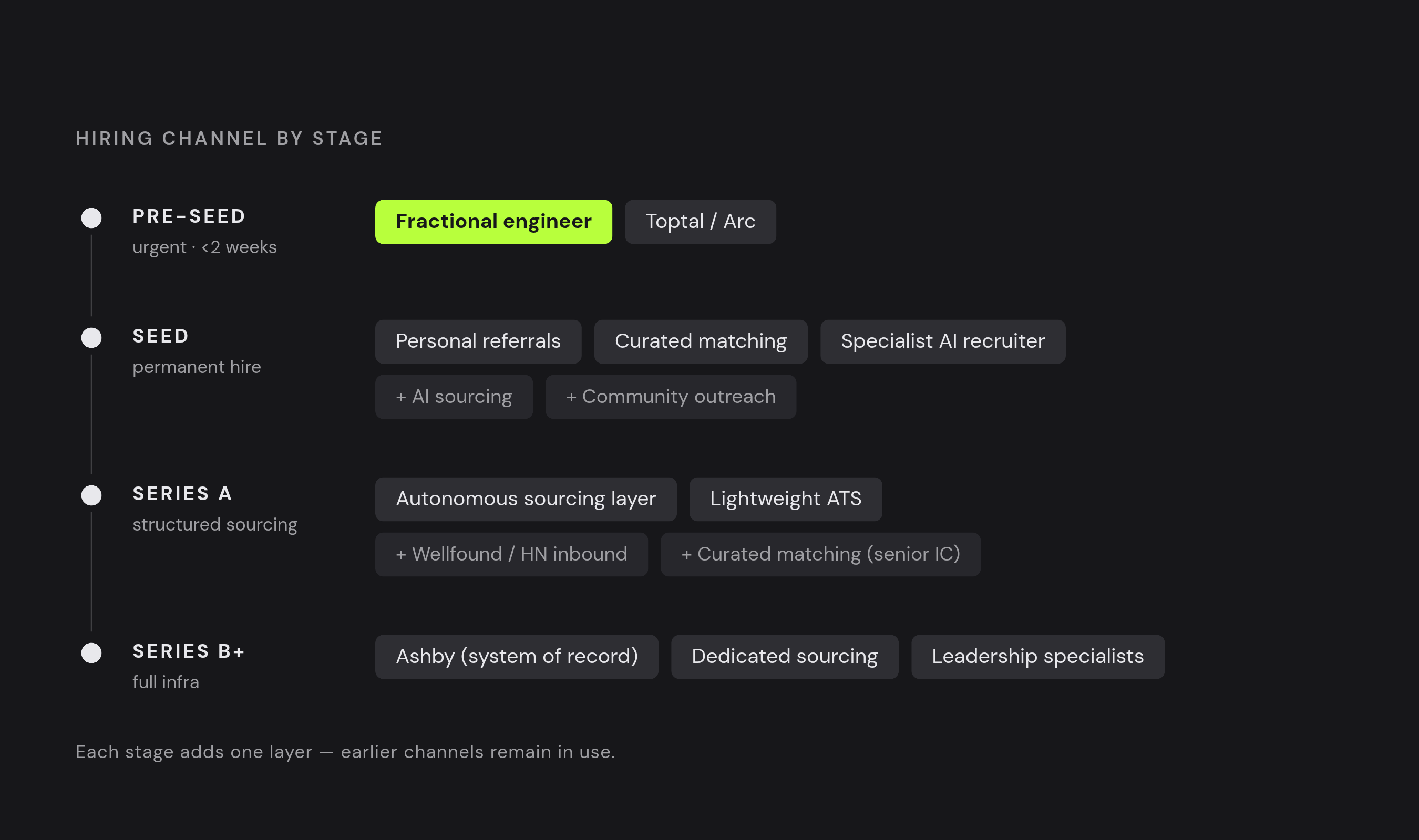
For a pre-seed company that needs work started in under two weeks, the first route is a fractional engineer or vetted contractor through Toptal or Arc. The search for a founding engineer should go on at the same time. For a pre-seed or seed company hiring that permanent owner, start with personal referrals and move promptly to curated matching or a specialist AI recruiter when those referrals run out. AI sourcing and community outreach can support that search simultaneously.
At Series A, a growing team can use an autonomous sourcing layer with a lightweight applicant tracking system. Wellfound and HN provide parallel inbound, while curated matching fits senior individual-contributor roles with a high bar and a small pool. At Series B+, Ashby can become the system of record, with dedicated sourcing feeding it and specialists handling leadership searches. Stage determines how much process is useful. It does not remove the need to reach candidates directly.
Role type then narrows the channel choice. Applied AI and LLM product roles fit open-source sourcing and curated matching, while agentic AI roles also fit applied-AI communities. Training, serving, and evaluation roles suit specialist recruiters or curated marketplaces, supported by GitHub and Hugging Face sourcing. Research roles point toward universities and NeurIPS, with specialist help for the senior lead. Infrastructure roles call for infrastructure-specific sourcing signals and specialist recruiters for senior positions.
The final test is whether the process reaches demonstrated skill and moves fast enough to close. A familiar channel is not necessarily the right one. Nor does activating more channels compensate for slow decisions once a strong candidate engages. The best option reduces both founder effort and the engineer’s cost of participating. A process that outlasts the candidate’s availability has failed, however organized it looks.