Why YC AI Founders Route Their First Engineering Hire Through Curated Networks Instead of Their Own Batch
Curated networks reach engineers a YC batch's competing founders can't.
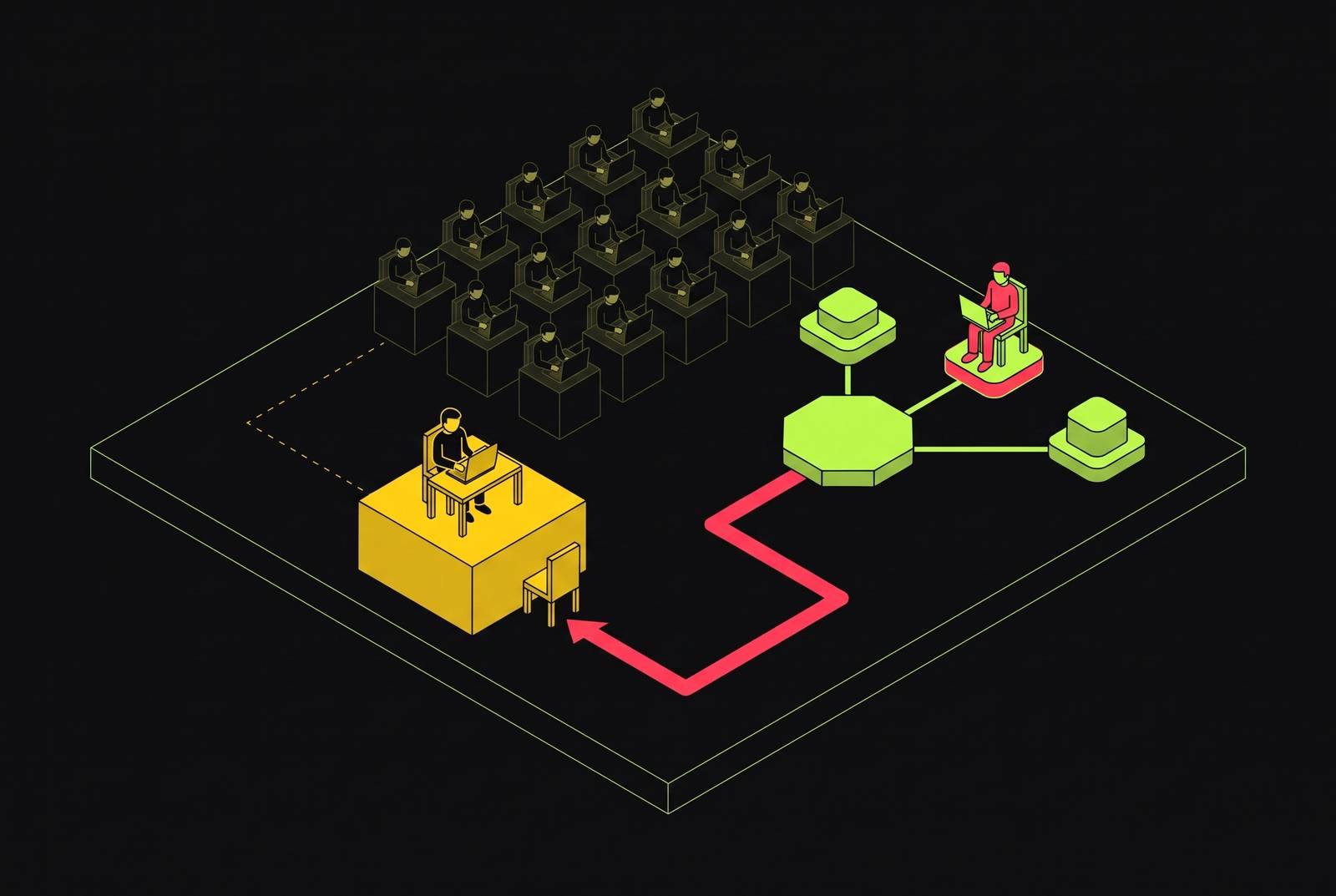
For technical founders, the first engineering hire for an AI startup should begin with trusted personal referrals, then move into a curated network before those referrals run dry. The YC batch is a map of competing employers. The advantage of a curated network is not more applicants, but earlier access to engineers whose work and fit have already been assessed.
Why the YC batch is a competitor map, not a candidate pool
Founders join YC expecting the batch to help them meet more people. It does, but a larger network of employers is not a larger supply of available engineers. The batch announces hundreds of companies at once, putting small teams into the market for their first engineer at the same moment. That concentrates demand within a cohort cycle.
Peers also share where their product is headed, who they want to hire, and how they plan to build. Recruiting across batches thus creates a conflict of interest on top of the work of finding someone who is free to join. The person a founder hopes to reach may be exactly the person another team is trying to close. Shared access does not mean shared incentives.
The TechTree First Ten report finds that 54% of cohort companies drew multiple engineers from one prior workplace. That pattern points toward existing working relationships at prior employers, where people know each other’s work. A batch connects companies that need that work done.
Why the best engineers are already placed before any batch posting exists
The strongest founding-engineer candidates have often already committed to a job by the time a batch would usually start hiring. They are working, and a move into a high-risk startup needs more justification than an open role appearing on a board. A trusted relationship can provide that justification before a formal search starts.
The First Ten report finds that winning companies hired their first engineer at zero months from founding, while companies that underperformed took four months. The earlier group was staffed before or at founding. That finding exposes a weakness in treating recruitment as something that starts after the company is underway. Some competing teams already have their engineer.
Job boards and batch marketplaces mostly reach people who are looking for a job. They do not reliably reach an engineer who would leave a compelling role only for a trusted referral. For that engineer, the destination needs to be credible before an interview process is worth entering. Trust works in both directions here. The company needs evidence that the engineer can build, while the engineer needs evidence that the founders are worth the risk.
How fast the founder's personal network actually depletes
Harj Taggar’s YC hiring framework puts personal networks first and recommends focusing exclusively there for the first three engineering hires. The reasoning is sound. Early candidates join because they trust the founding team. People who have worked with that team can judge it from more than a job description.
A founder’s reach is limited to several great engineers, few of whom may be free to join, want the job, and be right for it. The referral loop extends that reach through direct contacts and their contacts. Beyond those connections, however, the signal weakens because the person making the introduction may barely know the candidate. An introduction is not automatically an endorsement.
The framework also acknowledges that the network runs out and other channels become necessary. Founders who plan only for personal outreach can therefore find themselves unprepared for hires two through five.
What curated networks do that personal outreach and job boards cannot
A curated network extends the useful part of referrals beyond the founder’s own contacts. Candidates are pre-screened, referrals put someone’s reputation at stake, and the candidate receives information about the company through a trusted intermediary. Without those features, “curated” is just a label for another pool of names.
A senior engineer’s endorsement contains information a keyword match cannot provide. The referrer knows something about the candidate’s work and how they work with others, and risks their own professional reputation by recommending them. The candidate also learns something from who is willing to make the introduction. This two-way signal is especially useful when neither side has much public evidence about the other.
The alternatives place the work in different hands. Personal outreach reaches a few people with strong ties of trust, while job boards and marketplaces bring in more people for the founder to screen. Agencies can add speed, though their technical vetting may be thinner. A vetted talent partner does more of the assessment upfront, leaving the founder to choose among a small set of strong candidates.
The First Ten report finds that the median years of experience engineers had when they joined was lower at winning companies than at losing companies. It also finds that more than half the cohort attended schools outside any global top-100 list. Neither finding proves that a curated channel produced the result. Both cast doubt on filters that use seniority or school pedigree in place of proof that someone can do the work. Looking at how people work and what they have shipped can help find candidates those filters would miss.
Why hiring speed is not a process preference but a talent-quality constraint
A hiring bar is useful only while the candidate is still free to take the job. Strong founding-engineer candidates can have several offers at once and quickly drop out of hiring processes still underway. A company may be rigorous at every interview stage and still lose access to the people it wants. Taking longer to assess people changes who is still there to hire.
A long process favors people who can afford to wait, even when others are better suited to a high-ownership role. It may leave a founder choosing among people with fewer alternatives or less urgency. More elapsed time is not evidence of better judgment.
Direct hiring requires the founder to post the role, source candidates, interview, and close, which typically takes many weeks for a senior AI engineering position. A vetted partner can compress that work by moving screening ahead of the founder’s first conversation. The hire still needs time to ramp. Faster recruitment does not remove the work of learning the company and its product.
Curated screening pays off when it supplies credible evidence early enough for the founder to make a high-confidence decision. A shorter process without that evidence would rush the decision. A shorter process built on it can preserve both the hiring bar and access to strong candidates.
How the AI-native composition of recent YC batches intensifies the competition
The AI-native composition of recent YC batches concentrates demand around overlapping engineering skills. Companies may build different products but still need the same kinds of infrastructure and AI-fluent engineers. Their product differences do not separate their hiring markets. The pressure follows from what the teams need to build, rather than from a temporary surge in hiring enthusiasm.
The First Ten report finds that the infrastructure share of the first-ten engineering bench is highest early. The first two hires build the platform, while more of the people hired later finish the product. That puts the most foundational work at the point when a company has the least recruiting capacity. Across AI startups, those builders are also among the hardest profiles to find and the most competed for.
Remote-first posting expands the geographic pool and attracts meaningfully more inbound applications than in-office roles. More applicants still require someone to distinguish relevant shipping ability from a plausible résumé. As inbound volume rises, pre-screening becomes more useful because the founder’s time does not expand with the pool. The batch’s shared demand cannot be resolved simply by giving every company access to more applications.
What the founding engineer role actually requires and why role mis-specification wastes the search
A founder asking for “AI talent” may need a full-stack generalist who can turn existing models into a useful product. Asking instead for a research scientist can produce strong candidates for work the company does not need. Curated access makes that mismatch more targeted while leaving its cost unchanged.
The key distinctions concern the work itself. An AI engineer turns existing models into a useful product, while an ML engineer makes machine-learning systems reliable and scalable. A research scientist creates or validates new methods. These roles overlap, but their centers of gravity differ. Most seed-stage teams asking broadly for AI talent need the first.
The job can include front end, back end, databases, and deploys, with no platform team to absorb the gaps. Breadth of shipping capacity therefore takes priority over specialization at pre-seed. Even technical founders need someone who can take ownership across the work the company actually has.
Carta’s H2 2025 data shows that the median seed-stage team has just four employees. At that size, the founding engineer shapes architectural and product decisions. A specialist placed in a generalist role is constrained immediately by its scope. Accurate role definition is therefore a prerequisite for using a trusted network well, because the network can match only against the job it is given.
How should founders hire their first senior engineer with no recruiting process and no time?
The practical sequence begins with defining the work before activating any channel. For most seed-stage needs, that means a full-stack generalist with AI fluency and the ability to ship across the product. If the company genuinely needs an ML specialist or research scientist, the requirement should say so explicitly. Prestige is not a role requirement.
With that definition in place, the first sourcing move is the personal referral loop. Founders should list every engineer they have worked with, ask each directly, and ask who the best engineer they know is. The YC framework treats this as continuous work. It consumes substantial founder hours by design because the value comes from specific relationships and recommendations.
Founders should have the next channel ready before those relationships stop bringing in candidates. Engaging a vetted talent partner or curated marketplace at hire two or three gives the channel time to warm before hire four or five. The relevant criteria are pre-screened candidates, reputation-staked referrals, and evidence that the assessment goes beyond résumé credentials. A larger database alone does not meet that need.
The interview loop should then turn that evidence into a decision quickly. A 90-minute pairing session using real tools and actual shipped artifacts tells more about the work than a whiteboard screen. A short paid trial project can answer whether the candidate can do the job faster than a panel. The decision needs to be fast and well founded, because the candidate’s other offers are moving in parallel.