Series A Chaos Versus Series B Structure What ML Engineers Actually Thrive In
Series A rewards builders of repeatable systems; Series B rewards depth.
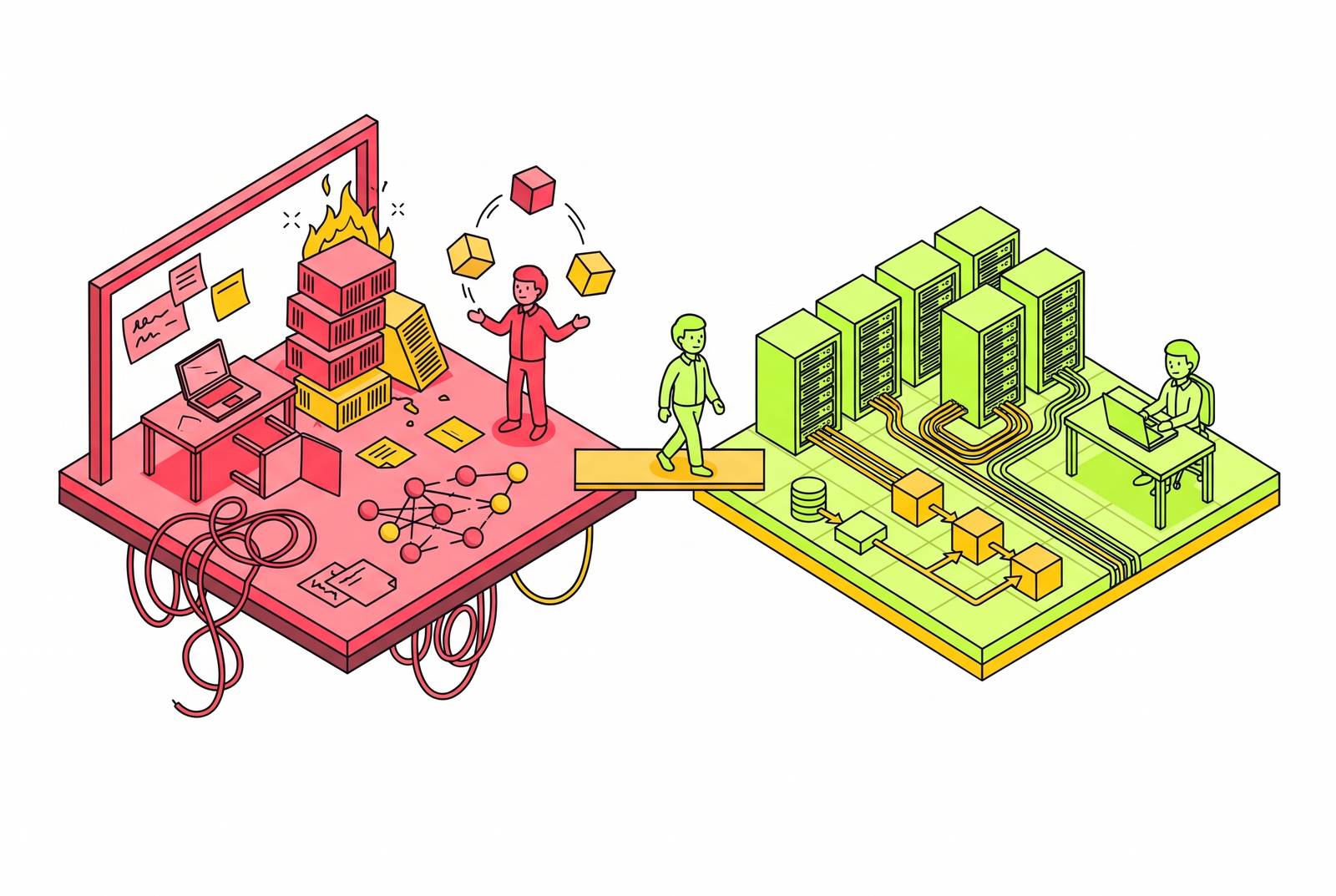
ML engineer career opportunities at Series A and Series B AI startups suit different ways of working, with room for the same ambition at either stage. Series A suits engineers who enjoy building repeatable systems from incomplete parts and owning the full ML pipeline. Series B suits engineers who do their best work through deep specialization and defined ownership. The right choice depends on which working conditions bring out your best work.
Why stage matters more than seniority for ML engineers choosing where to work
Compensation, team pedigree, and problem domain are obvious ways to compare jobs. They reveal less about how the work will actually happen. An engineer can find the problem compelling and have the technical skill to solve it, yet struggle with how decisions get made or how responsibility is divided. Stage fit is a separate variable. It needs attention before the engineer joins, before the way the company works starts to frustrate them.
A senior engineer may know how to work without set processes but dislike having to build them every day. Another may be capable of deep specialization yet find a defined remit constraining. Neither preference establishes who is stronger technically. The useful distinction is between work an engineer can perform and conditions under which that engineer consistently does their best work.
What the organizational shift from Series A to Series B actually feels like on the ground
At Series A, a hallway decision can become the team’s shared understanding without anyone writing it down. Context travels through proximity and osmosis. Engineers know why a priority changed because they were part of the conversation, or close enough to absorb it. That makes the team's informal way of working together feel natural and complete. Those habits start to fail when they leave out people who need the information.
The change can be hard to name. The team feels slower even though people still have the same conversations. Series B replaces that informal context with a decision archive, written digests, defined ownership of parts of the system, and hired engineering managers. These are substitutes for something the smaller team got almost for free. To an engineer who liked absorbing context as it happened, the replacement can feel like drag, while another gains the clarity needed to work deeply.
Headcount alone is becoming a less reliable guide to this transition. AI tooling in 2026 lets engineering teams ship more with fewer people, so many teams stay at the lower end of the Series B headcount range for longer. The organizational shift can therefore arrive at a smaller absolute team size than in prior cycles. Funding stage gives some context, but how decisions get made shows what each day will be like.
The characteristic failure mode at each stage — and what it reveals about what each stage actually demands
At Series A, the characteristic mismatch is an engineer who needs delivery systems to exist before productive work can begin. The company instead needs someone who can build those systems while shipping. Research-mode exploration can produce a similar mismatch when the immediate need is a concrete tradeoff and a release. Technical strength does not replace the willingness to turn incomplete work into something repeatable.
By Series B, the dysfunction becomes more visibly financial. A company can employ many ML and platform engineers yet fail to ship dependable AI features with sane gross margins. Hiring can increase coordination work and infrastructure costs faster than it creates revenue leverage. More people do not automatically mean more useful output. Specialization only helps when engineers can turn their defined responsibilities into dependable contributions to the wider system.
Revenue per engineer provides a stage-indexed sanity check. Healthy companies sit in materially different bands at different stages, so the same expectation cannot sensibly apply to both. When AI hiring runs ahead of that benchmark, success in filling jobs can hide how poorly the company is scaling. For an engineer evaluating the company, this distinction exposes the real demand. Series A needs repeatability imposed on chaos, while Series B needs leverage from structure.
The ML engineer who thrives at Series A — and the specific working preferences that predict it
The strongest Series A fit starts with product curiosity. This engineer uses the product without being asked and offers feedback because technical choices and product choices are hard to separate. The work is not finished at the model. Latency, cost, and accuracy are interesting tradeoffs within the “real” task. Turning a prototype into a shippable product depends on those decisions.
That curiosity goes with broad ownership. At Series A, ML platform, evaluation engineering, and data engineering may not exist as separate roles, leaving one engineer responsible for work from training data to monitoring dashboards. The engineer who enjoys that breadth has a reason to welcome the job’s loose boundaries. Prior experience with early-stage chaos can help, even in another domain. Shifting priorities, missing processes, and deploying to production multiple times a day then feel like familiar working conditions.
This profile is not a badge of toughness. An engineer whose experience is entirely in large companies may struggle if delivery systems have always been provided, but the relevant issue is dependence on those systems. Similarly, an engineer who answers every tradeoff with “it depends” without reaching a view may be poorly matched to the pace of decisions. Most Series A companies need an ML generalist who can handle data pipelines, feature engineering, training, and productionizing. A research-leaning profile makes more sense when research output is the core product.
The ML engineer who thrives at Series B — and what changes when structure is the starting condition
The Series B fit is an engineer who wants to go deep on a defined part of the system. Named scope makes that depth possible. Rather than keeping the whole pipeline in their head, this engineer finds leverage through specialization in platform, data, security, or evaluation. Missing expertise in those areas can bottleneck the organization. A defined surface is therefore not a smaller version of the Series A job, but a different way to contribute.
That preference includes accountability after deployment. An engineer who accepts being paged when a model drifts treats production behavior as part of ownership. The ML platform and infrastructure profile becomes distinct and scarce at this stage. Its appeal is sustained responsibility for a specific surface. An engineer who resists those boundaries can create coordination failures even while doing strong individual work.
Series B candidates are right to expect proof of ARR growth, user retention, runway, and team stability, and to put less weight on faith in the founding vision. They also expect to speak with engineers without leadership present and see real operational data. Proof is part of the evaluation. Sharp questions about evaluation strategy and how ML decisions get made reveal an engineer’s understanding of structured ownership, regardless of the stage of the company interviewing them.
How title confusion between AI engineer, ML engineer, and research scientist creates stage-mismatch before the interview begins
An AI engineer typically turns existing models into a useful product, while an ML engineer makes machine-learning systems reliable and scalable in production. A research scientist creates or validates new methods. The boundaries overlap, but the center of gravity differs. An attractive title does not tell an engineer which of those outcomes the company actually needs.
Frontier labs complicate the language further. The historical division between research scientists, typically PhDs, and research engineers, typically MS/BS graduates, has blurred where engineering decisions are inseparable from scientific outcomes. Most Series A and B startups generally need a research engineer or ML generalist unless research itself is the product. Borrowing a title from a lab does not establish the same kind of work.
For the candidate, the practical step is to confirm the role category before the first technical screen. Questions about monitoring, failure modes, retraining decisions, and data pipelines expose whether production responsibility is central or incidental to the role. The company’s answers also reveal whether it knows which profile it needs. Knowing the stage will be of little help if the assessment is built around the wrong job.
How do you evaluate compensation and equity in a Series A versus Series B ML engineering offer?
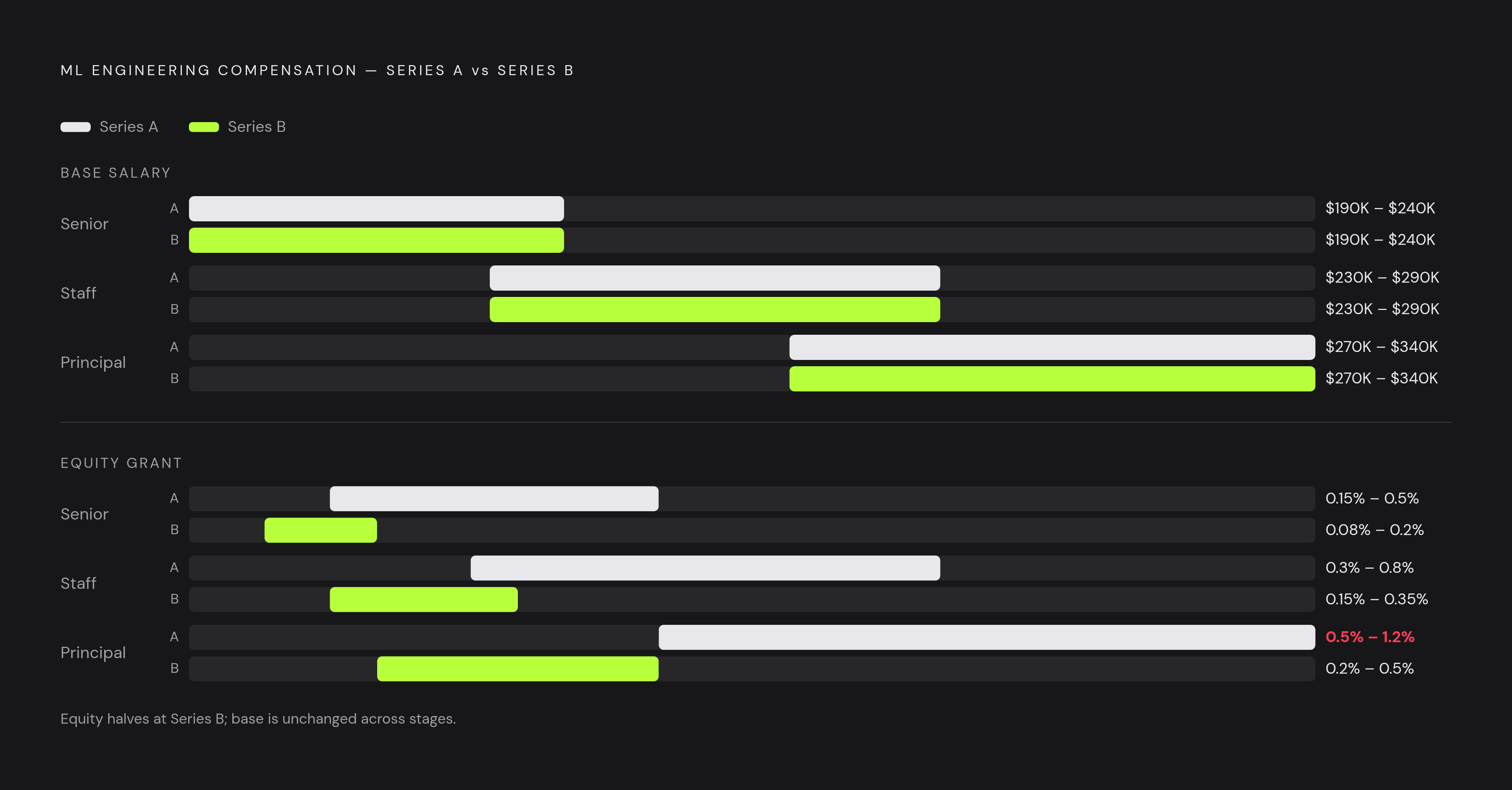
Recruiting from Scratch’s placement data shows ranges for base pay at US startups by seniority, with different equity ranges for each stage. A Senior ML Engineer at Series A or B has a base range of $190K–$240K, with 0.15%–0.5% equity at Series A and 0.08%–0.2% at Series B. The Staff ML Engineer range is $230K–$290K base, with 0.3%–0.8% at Series A and 0.15%–0.35% at Series B. Principal ML Engineers fall at $270K–$340K base, with 0.5%–1.2% at Series A and 0.2%–0.5% at Series B.
Candidate circumstances also change the comparison. Remote candidates in non-coastal markets usually accept 5–15% less on base, while those leaving large tech companies may need pay that makes up for some of their unvested RSUs. NxtLevel’s engineering compensation data places frontier-lab research engineers from OpenAI, Anthropic, or DeepMind materially above these base ranges, with realistic total compensation well above the Series A/B ranges. Those are different reference points. A package needs to be read against the role and ownership context.
The equity instrument changes what ownership requires in practice. Options require paying a strike price to own shares, so employees need cash and face more complex taxes, while RSUs vest as ordinary income without a choice about whether to exercise. Series A grants are typically options, and grants at Series C and beyond are more often RSUs. Series B does not automatically mean a different instrument. Confirming the grant type is therefore part of understanding the offer.
The percentage also needs its surrounding terms. Dilution changes ownership over time, and a planned option-pool expansion can change the denominator early in an engineer’s tenure. The post-termination exercise window determines how quickly a departing employee must act. A 90-day window is a common default, while some companies extend it to one to five years. That difference can force or postpone a costly decision, making the window part of the package’s practical value.
How to use working preferences, not just credentials, to make the call
The decision starts with an honest audit of working preferences. Do you enjoy imposing order on a system that does not yet exist, or going deep on a surface within one that already works? When information is incomplete, do you prefer making a call and iterating, or gathering more signal before shipping? Neither answer proves greater technical ability. The first preference points toward Series A, while the second can be a strength in Series B’s more structured environment.
Ownership provides another test. Would you rather take responsibility for the full ML pipeline or develop depth within a named scope? If you have worked without stable evaluation, observability, or data loops, did building those foundations feel interesting or like an obstacle to doing real work? Past reactions are useful evidence. Compensation and prestige cannot resolve a mismatch between the job’s daily demands and the work an engineer actually wants to do.
That self-assessment pays off before the first screen. Knowing the funding history, role scope, equity range, and organizational mode narrows the field to opportunities where an engineer can thrive. A curated matching process that surfaces this context early can complement that judgment by finding and referring engineers with the relevant fit. The next interview is a chance to test whether the company’s actual working conditions match the preferences already identified.