The Fastest Path From Hiring Decision to Senior Engineer Offer Without a Single Recruiter Call
Curated matching, warm intros, and direct outreach get senior engineers to hiring managers faster.
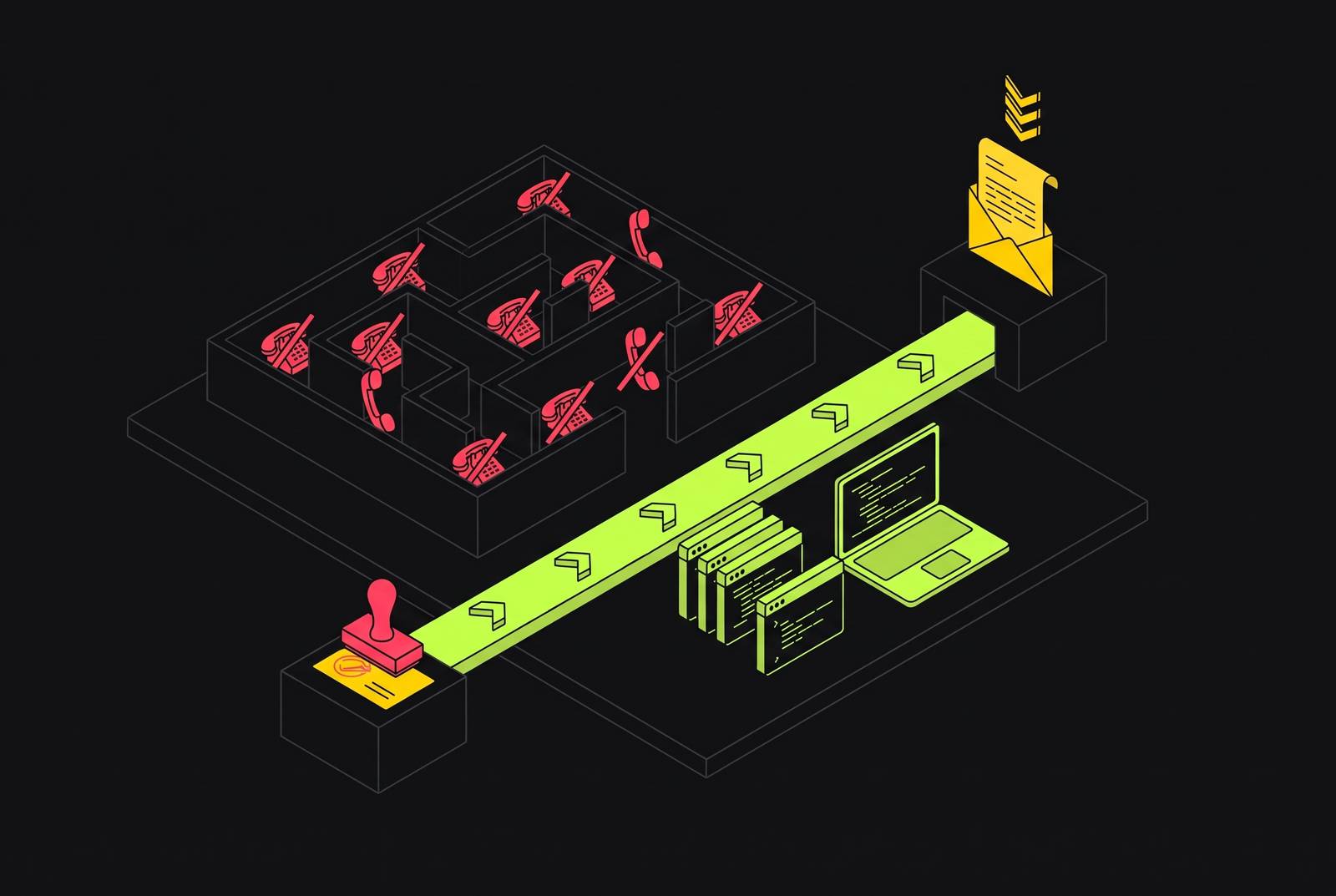
The fastest path to a senior engineer offer in 2026 runs through curated talent matching, warm introductions, and direct founder contact. For senior ML and software engineers joining AI startups, curated matching is the best place to start because companies show interest before the engineer spends time on a call. The aim is to reach someone who can make a hiring decision without first waiting for a recruiter screen.
Why the application funnel stopped working for senior engineers in 2026
The slowest paths ask engineers to do the same work over and over. The fastest require less once the groundwork is done. A senior engineer can spend weeks tailoring applications before getting a first recruiter call, while a matching profile can draw interest from companies within hours to days. That inversion comes from where hiring teams now look.
AI made it cheap to produce applications in large numbers. Automated rejection made them cheap to sort through, too, as hiring managers grew less willing to trust the inbound pile. More submissions therefore put more of an engineer’s work into a channel that decision-makers increasingly avoid. A better resume alone cannot change where those applications go.
Traditional technical recruiting agencies do provide a human intermediary between candidates and employers. That can be useful when a role needs explanation or fit needs discussion. But an intermediary also adds a conversation before the engineer reaches the person deciding whom to hire. When the objective is speed without a recruiter call, that sequence is the constraint. Matching and direct contact change the sequence rather than asking candidates to move through it more efficiently.
The four channels that reach offer without a recruiter call, ordered by speed
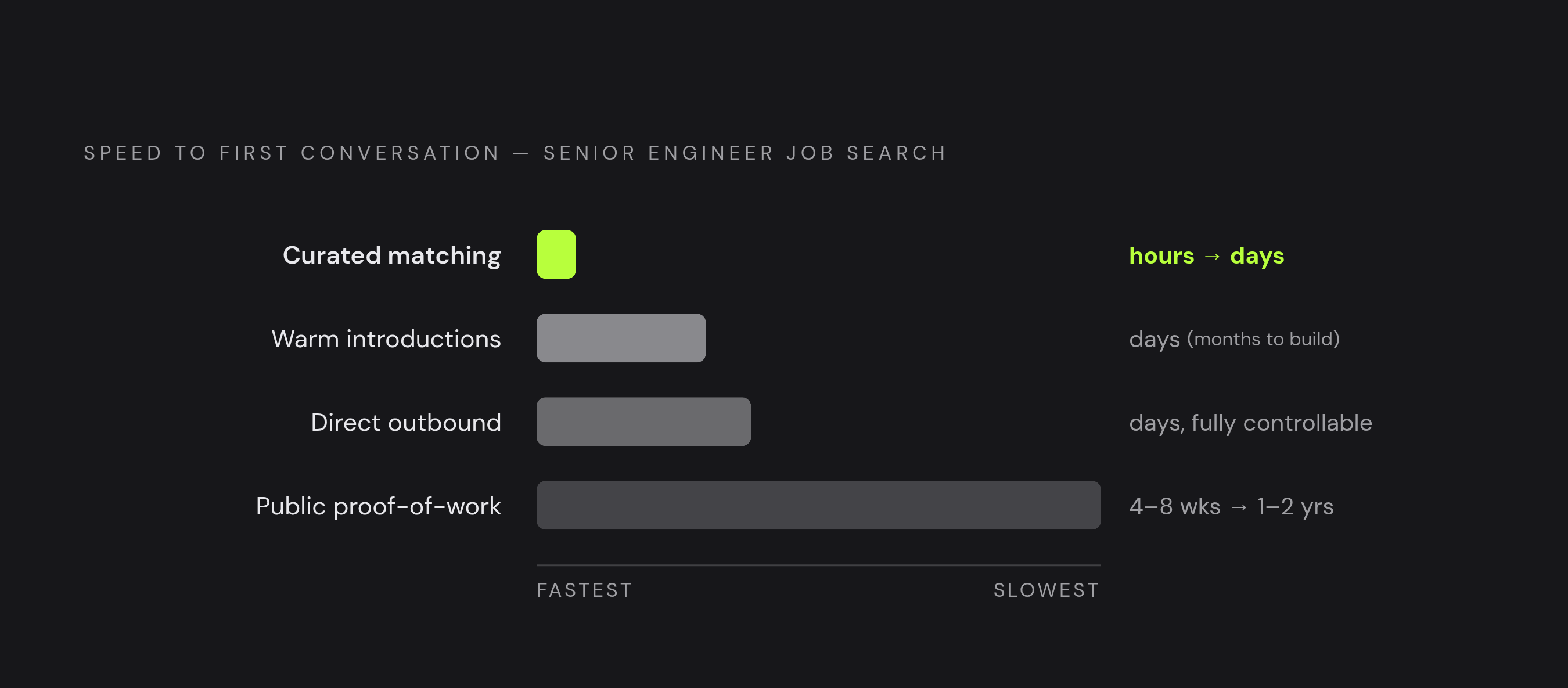
Curated matching comes first for most senior engineers, with initial contact possible within hours to days after a profile goes live. Warm introductions come next when the engineer already knows people who can help. Direct outbound follows as the controllable route to specific founders and engineering leaders, with responses possible in days. Public proof-of-work comes last because it takes longer to establish, although it can generate opportunities for years.
This is a priority order for pursuing the four channels one at a time. An engineer with a trusted contact at a hiring company may have a faster route through that introduction than through any platform. Someone without that connection should lead with matching. These timings concern access to a conversation. Technical assessment and a hiring decision still have to happen.
Curated talent matching: the fastest channel for most senior engineers right now
Curated matching reverses who has to show interest first. Instead of submitting an application and waiting for a screen, the engineer receives interest from a company that has already considered the match. That changes the starting point of the conversation. The company is not merely processing another applicant. It has a reason to talk to this engineer.
For senior ML engineers considering early-stage AI companies, the useful comparison is therefore not simply how many jobs a marketplace lists. It is whether the service screens engineers, recommends them to relevant companies, and brings back qualified interview interest. Upfront salary information makes that interest easier to judge. A broad collection of listings and a curated matching service do different jobs, even when both help people find work.
The engineer still has work to do. Matching depends on a carefully built profile, evidence of shipped work, and a willingness to decline companies that do not fit. Treating every introduction as worth a call gives away much of the time the channel saves.
That selectivity starts with information a hiring team can read quickly. A broad title leaves the company to infer the engineer’s stack, preferred stage, and strongest kind of work. Specific evidence lets it assess fit before reaching out. Matching is fastest when the profile answers those questions before they need to come up in a first conversation.
Warm intros: the highest-conversion channel for engineers whose network is already warm
The engineer is not arriving as an unknown name in a queue, but through someone connected to the hiring team. That makes referrals a strong conversion channel for senior and remote engineers.
Warm introductions can lead to offers quickly, but it takes months to build the relationships that help. An engineer whose last three roles were at one company may have a strong reputation and still have a small, concentrated referral pool. Familiarity within one organization does not automatically create access to founders elsewhere.
For someone in that position, the practical move is to build the network while using matching for the immediate search. Slack communities for specific disciplines, in-person events, conference panels, and structured one-on-ones are ways to build those relationships before a role urgently needs to be filled. They are not an instant substitute for an active hiring channel. Treating networking as a crisis response asks new relationships to do work they are not yet ready to do.
An introduction should come first when it reaches someone who is hiring now for the right work.
Direct outbound to founders and engineering leaders: the most controllable recruiter bypass
Matching depends on which companies show interest, while referrals depend on who knows whom. Outreach lets a candidate choose a company and contact the person who is in charge of its technical hiring. It takes more hands-on work, but that work goes to a named decision-maker.
The message needs a specific reason to exist. A contribution, public pull request, project, or technical decision that relates to the company gives the outreach more to say than a general request for a job. It shows why this company and this engineer belong in the same conversation.
There is a process wrinkle at companies with recruiters. Contacting only the recruiter can leave the message short of the decision-maker, while contacting only the VP of Engineering can still run into a recruiter-controlled process. Where both are involved, the recommended approach is to contact both in the same outreach pass. Direct outreach therefore cannot promise a recruiter-free loop everywhere.
Founding engineer and first-of-function leadership roles are more structurally direct. A single decision-maker can control the loop, which typically includes three to four stages involving a founder screen, a hands-on build session, deeper founder conversations, and informal reference checks. Seed and Series A hiring for these roles is active, even while non-revenue mid-level hiring is more selective. Founder-led interviews within five business days correlate with higher acceptance rates, making the company’s pace part of the opportunity’s appeal.
Running a search from inside a job while keeping it invisible
The engineer has a reasonable manager but expects the next few years to resemble the last few. In that situation, confidentiality determines which search activities are practical. A faster route is not useful if pursuing it unnecessarily exposes the search at work.
For an employed engineer, the practical rule is separation. Keep the search off company devices and the company VPN, and use personal email for every application or hiring conversation. Corporate monitoring can include keystrokes, screen capture, browsing and application activity, and email or messaging inspection. Treat Slack and Teams messages as discoverable. Keep calendar events private and give them titles that do not reveal the search.
If the employer finds out, more than an awkward talk may follow. The engineer may be taken off important roadmap work, passed over for promotion, or put at greater risk of losing their job during a reduction. There is no need to make that possibility dramatic to take it seriously. The search belongs outside the employer’s systems.
Curated matching suits this constraint because it does not require a visible application campaign, a public Open to Work badge, or candidate-initiated recruiter calls during business hours. That structure is useful, but it is not a blanket privacy guarantee. For a quiet search, switch the badge to “Recruiters only” or remove it. The signed offer is the first point at which the current company needs to know.
Public proof-of-work: why GitHub and open-source contributions replace the resume as the sourcing signal
Public proof-of-work is not a solution for this week. Establishing basic credibility can take two to four weeks, generating quality inbound can take four to eight weeks, and building a lasting open-source reputation can take one to two years. Its value is durability. Work that remains visible can keep introducing an engineer to people with hiring authority after the immediate search ends.
GitHub lets those people inspect more than a claim. Commit frequency, repository depth, and contribution history show aspects of what an engineer has built and how they participate. A thoughtful issue, well-documented pull request, or substantive contribution to GitHub Discussions also puts the engineer in front of maintainers. Some of those maintainers influence hiring directly.
That does not make a quiet profile a warning sign. Many senior engineers have spent years shipping large systems in their companies’ private repositories. Their public contribution history says little about that work. Using GitHub activity to judge every engineer would rule out the very people with experience that a hiring team may need.
For engineers with thin public footprints, matching and direct outbound are the immediate moves. A public artifact layer can develop beside them. Hacker News “Who wants to be hired?” threads and conferences such as KubeCon, PyCon, and QCon also create opportunities to become visible without first accumulating a large open-source record.
How to position yourself to be pulled through the fast channels rather than overlooked by them
Technical strength needs to be legible at a glance. In an 8-second profile scan, a hiring team may look at the headline, current role, last shipped thing in the about section, location, and two skill tags. “Software Engineer” uses the most visible space without explaining fit. A headline that names the specific stack, company stage, and type of problem gives the reader something to recognize.
One concrete shipped feature, system, or measurable outcome in the about section gives the company a basis for a technical conversation. For AI and ML roles, that conversation should be able to reach evaluation quickly. Golden datasets, human review loops, regression testing for model behavior, and catching silent quality degradation show how an engineer thinks about what comes after getting a model to produce an answer.
Role labels need the same precision. An AI engineer uses existing models to make useful products, while an ML engineer builds and trains ML systems and makes sure they are reliable and scalable. A research scientist creates or validates new methods and almost always requires a PhD. Most Series A and B AI startups need the first two. Positioning for the wrong category can obscure a strong fit.
Among the matching options, Fonzi describes itself as a curated, invitation-style marketplace for leading ML and software engineers, screened from a large pool of reviewed profiles, seeking AI startups and high-growth tech companies. It recommends engineers to matched companies and delivers interview requests with salary bids upfront, without an application or recruiter call.
Replace the generic headline, write up one shipped result, and complete the matching profile during week one. Instead of another round of resume polishing or auto-apply submissions, build a one-page proof-of-work site and a target-company list with named founders. Use that list for direct founder outreach in week two, after the matching profile is in place.