Best Hackathons in SF and NYC for Engineers
Agentic AI dominates this year's hackathons, and winning matters more than prize money.
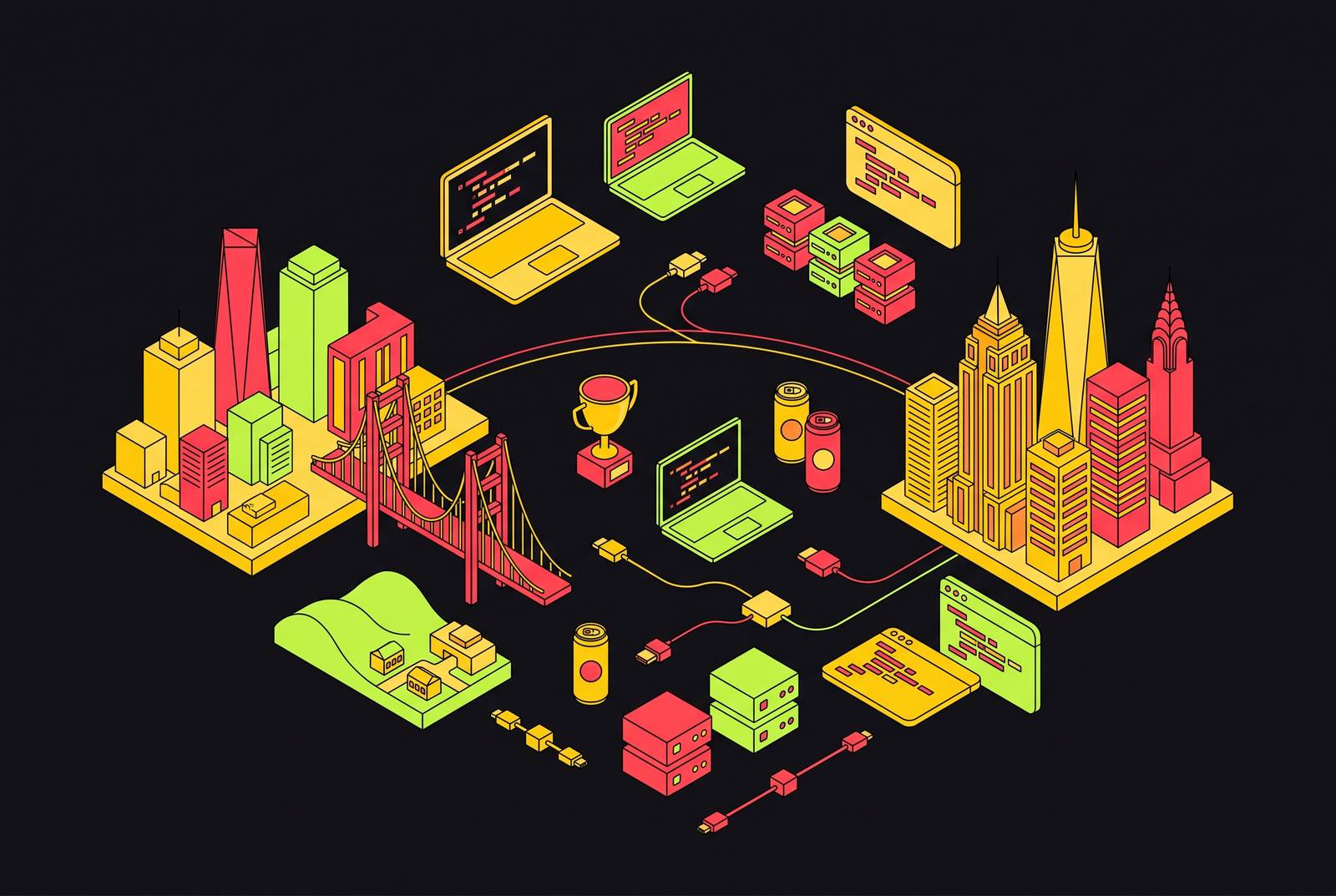
Every major hackathon in San Francisco and New York this year has reorganized itself around one technical theme: agentic AI. These agents plan, they delegate, and they recover from their own errors, but they run with little human oversight. More than 1,500 builders and enterprise leaders came to the AGENTIC AI Summit 2026 over three days, and you can see that scale across the rest of the calendar too. Whether an event is backed by a hyperscaler, a frontier lab, or an independent community, the build prompt this year keeps landing on the same territory: persistent agents, recursive self-improvement, multi-model orchestration.
It reflects a real expectation at AI-first startups that engineers will ship agentic systems starting day one, not work up to them. That expectation has compressed what used to be a sprawling, loosely-themed calendar into something closer to a coherent signal. Attend the right events in 2026 and an engineer ends up in the room where the problems companies are actually hiring for are being built in real time, not simulated for a demo. When that many events point at the same target, you can lose time and opportunity by picking the wrong ones, so you need to know what each event actually offers, more this year than in years past.
What hackathons offer an engineer's career beyond prize money
The clearest case for what a hackathon can do sits in a single event: the Google DeepMind × InstaLILY AI Hackathon, held February 28, 2026 in San Francisco. Winners there got on-the-spot job offers from InstaLILY AI, because the company's founding engineers judged the event in person. That is a hackathon functioning as a live hiring event, not a resume line. Prize money is almost beside the point next to that outcome.
Most of the career value of a hackathon comes from three things a job application can't replicate: public work a hiring team can actually see, direct exposure to the people doing the hiring, and a fast, visible way to show what kind of engineer someone is. On that third point, hackathons do something job descriptions consistently fail to do: they separate the ML engineer optimizing an inference pipeline, the research engineer implementing a novel architecture, and the applied or product engineer shipping the demo, in public, in real time. Those three roles get blurred together in most postings. A 24-hour build makes the distinction obvious to anyone watching.
AGI House events in San Francisco show a related pattern from the other direction: founder discovery. Participants there are often founders or senior engineers already. They get one session, built around a brand-new model release, to get a demo running before the room empties out. The founding-engineer-to-early-hire pipeline is most visible at these sessions, because the people in the room are frequently doing the hiring themselves. Talent sourcing desks at the top events now treat hackathon leaderboards the same way they treat GitHub activity or a presence on X: as a place to search, not just a place to watch. Showing up and placing well gets indexed.
The strongest knock on hackathons is fair: most reward speed of prototyping over depth of engineering, and a fast demo can misrepresent what someone can actually ship in production. Winning the event is only half the value. The GitHub repo, the demo video, and the conversations that happen after the judging ends are what carry forward into an actual job conversation. Engineers who treat a hackathon as a portfolio entry, rather than a contest to win outright, get more out of it than the engineers chasing the trophy. That's especially true for anyone with deep domain expertise in a vertical like biology, finance, or robotics: at events full of generalists, that kind of specific knowledge reads as signal instead of noise, and it's a stronger way to compete than trying to out-code the room on raw speed.
The flagship SF events, broken down by what they offer engineers
San Francisco's hackathon calendar is the densest in the country for applied AI, and the events worth prioritizing split into three types: conference-satellite events with unmatched hiring exposure, focused community builds with vetted and competitive rooms, and broad umbrella weeks that function like a distributed job fair spread across several days. The Google DeepMind × InstaLILY event already covered above is the clearest example of the hiring-pipeline category.
The prize pool has substantial cash prizes and partner credits, and winners went on to the main stage at Startup Battlefield on July 2. The parent conference is billed as the largest technical AI conference in the world, with dozens of tracks, hundreds of speakers, expo partners, and thousands of AI engineers, founders, and VPs of AI in attendance, so hackathon participants get immediate exposure to the single most concentrated applied-AI hiring pool on the calendar. If you want a founding or senior AI engineering role and you want the biggest audience watching you build, this is the event to pick.
The Recursive Agents Hackathon runs October 17, 2026 at Shack15 in San Francisco. Teams of up to four build persistent AI agents that plan, delegate, recover from errors, and operate with minimal oversight, using infrastructure from Crusoe Managed Inference and NVIDIA, with open models like Nemotron available to build on. The prize pool runs $25,000 in cash plus an NVIDIA RTX 5090. If you want a tightly scoped agentic build, serious hardware on the line, and a field that's been vetted rather than wide open, this is the one to pick.
SF Tech Week Hack Week runs October 5 to 11, 2026, and it's the broadest umbrella event of the fall season: hackathons, technical talks, demos, fireside chats, and build sessions hosted by companies, universities, and developer communities across the whole week. SpeedHacks closes the week out as its official closing hackathon. Confirmed sub-events include Engineering at Scale with Astro Teller and Google DeepMind on October 6, Camp AI: Production-Ready Agents also on October 6, the Harness Engineering & Model Wrangling Hackathon on October 11 in San Francisco, and Hack Alcatraz with Cloudflare and Kling AI on October 5. If you want to sample multiple communities and multiple employer brands in a single week, without locking into one event's format, this is the one to pick.
The TechCrunch Disrupt Hackathon runs October 13 to 15, 2026 at Moscone West. Past winners of this event have gone on to launch successful startups, which makes it the strongest fit for engineers with startup ambitions who want a demo judged on both technical merit and commercial potential.
Machine Learning Week Hackathon runs May 5 to 6, 2026 at the Clift Royal Sonesta, with a focus on hybrid AI approaches that combine generative and predictive AI. Judges here score technical sophistication and production readiness over raw speed, so if you're a working ML practitioner who wants to show depth over velocity, this is the right fit.
GitHub Universe Hackathon runs October 28 to 29, 2026, centered on developer tools and productivity. Judges score code quality, inventive use of GitHub's own features, and practical utility. If your career case is built around developer tooling, DevOps, or open-source infrastructure, this is the right venue.
Supabase Select 2026 Hackathon runs October 3, 2026 in San Francisco, in person, and carries one of the largest single-event prize pools on the entire SF 2026 calendar, a notable draw on its own for engineers weighing which single day to commit to.
World Labs Hack 01: Spatial Intelligence ran February 27, 2026 in San Francisco, hosted by World Labs and featuring founder Fei-Fei Li alongside key engineers from the company [01]. Builders worked with Marble, World Labs' generative 3D world model API [01]. Prizes covered first, second, and third place with cash and Marble API credits, and an honorable mention carried API credits alone. This event suits engineers targeting robotics or physical AI tracks specifically.
The flagship NYC events, broken down by what they offer engineers
New York runs a smaller hackathon calendar than San Francisco by volume, but it's a more curated one. The strongest events here are capped, vetted, and built around tight technical communities instead of wide open calls, which changes how engineers should think about networking at them: fewer people in the room, but a higher fraction of them worth meeting.
AI Tinkerers NYC runs as a recurring community series throughout 2026, and it functions as the backbone of the city's builder scene: a hands-on AI meetup for people who want live code demos, real technical discussion, and networking without a pitch attached. Several confirmed hackathons sit inside the series. NYC Vision Hack v.2: Live Feeds, Open Data ran August 7, 2026, with developers building AI agents and computer vision prototypes on live NYC city data, supported by Google Cloud, Roboflow, and Veris AI. Spots were limited and submissions locked at 8:30 PM. The Emotionally Intelligent AI Hackathon with ElevenLabs ran June 6, 2026 as a full-day event capped at 100 to 150 vetted builders with RSVP required, focused on emotion-aware agents, detection and evaluation pipelines, safety guardrails, multilingual emotion transfer, and expressive creative avatars. The Generative Media Hackathon with ElevenLabs ran April 11, 2026, centered on building ethical generative content infrastructure at scale. The AI Interfaces Hackathon with Claude ran February 21, 2026, bringing designers and engineers together to explore new AI interfaces with support from Anthropic. This series rewards engineers who want one consistent community to plug into across the whole year, since the value compounds the more of these an engineer shows up to, rather than engineers looking for a single one-off event.
The New York City Hackathon runs August 15, 2026 in Manhattan as an eight-hour sprint focused on AI, and it's aimed at top interns and new grads, so it caps at roughly 100 builders. Sponsors set the tracks, and each one is a real problem announced at kickoff, so every project gets scoped and shipped within the same day. A panel of sponsors and organizers scores every demo on what you built in those eight hours. If you're earlier in your career and want a fast, structured build judged directly by the companies doing the hiring, this is the right event.
DeveloperWeek New York 2026 Hackathon runs as a hybrid event, with an online phase from May 25 to June 10 and in-person awards June 9 to 10 at the TWA Hotel, co-located with AI DevSummit New York 2026. More than 300 developers take part building new apps, bots, and related tools. Most of the networking and hiring value concentrates in those in-person sessions at the TWA Hotel regardless of how much work happens during the online phase, so engineers who want flexibility in timing but still need the in-person close should plan around June 9 and 10 specifically.
The Harness Engineering & Model Wrangling Hackathon NYC runs September 26 to 27, 2026, in person, with a substantial prize pool. It shares a brand with the SF Tech Week edition of the same hackathon, so if you win here, the same hiring networks on both coasts will see your work. So if you want cross-coast exposure without the cost of traveling to San Francisco, this is a strong option.
The AI Summit New York Hackathon runs December 9 to 10, 2026, onsite at The AI Summit New York, and it's built for the city's data science and engineering community, so it pairs a bespoke competition with a mentoring component. It's suited to engineers who want structured mentoring alongside the build itself, especially later in the year when most of the calendar has already closed out.
The AI Club × Iterate NYC Hackathon, run through Columbia Business School's AI Club alongside Iterate, brings together a large cohort of builders for a day-long hackathon, and they go from idea to working demo in a single day. Engineers looking for exposure to the CBS founder and investor community in a structured build format will get the most out of this one.